
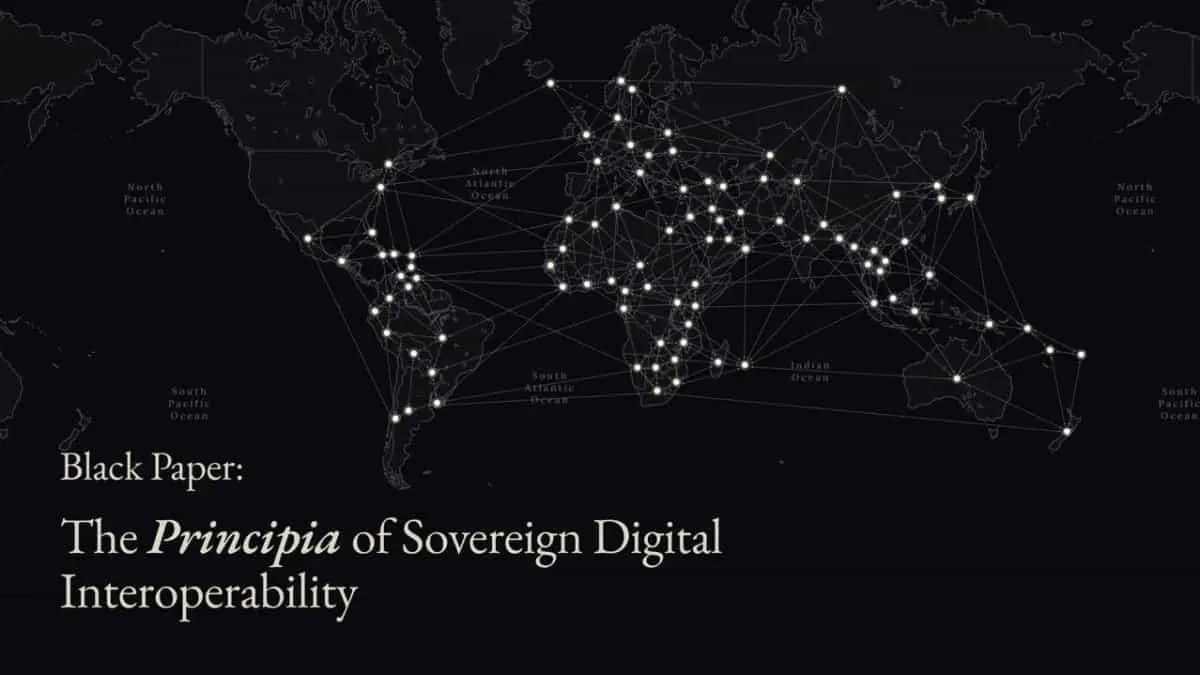
Digital settlement is no longer experimental. Stablecoins have reached large-scale adoption, with transaction volumes exceeding trillions of dollars annually, reflecting global demand for programmable, always-on value transfer. At the same time, banks and market infrastructures are developing tokenized deposits, DLT settlement systems and multi-bank networks outside the open stablecoin economy.
Rather than converging on a single architecture, stablecoins, tokenized deposits, CBDC experiments and bank-led systems are evolving under different regulatory regimes and governance boundaries.
That is the starting point of The Principia of Sovereign Digital Interoperability (Black Paper): as global digital finance develops across multiple ledgers, issuers and regulatory domains, how will trust continue across systems that remain sovereign, regulated and institutionally different?
The market is moving, but not converging
The pattern is visible on both sides of digital settlement.
Stablecoins and tokenized deposits are scaling in parallel across different issuers and regulatory regimes, rather than converging into a unified settlement layer. The same asset may move quickly on-chain, but its legal, compliance and supervisory meaning can differ across jurisdictions.
On the regulated-finance side, banks and market infrastructures are building parallel digital settlement systems, including tokenized deposits, bank-led DLT networks and consortium-based initiatives. These systems are moving from pilots toward early commercialization, with projects such as JPMorgan’s Kinexys, HSBC’s tokenized deposits, Fnality’s wholesale settlement system, and central-bank-linked experiments like Project Agorá illustrating a broader trend of parallel development rather than convergence.
Overall, digital settlement is not converging into a global settlement layer, but expanding into a fragmented landscape of parallel systems.
The missing layer is coordination
The harder problem is not whether value can move between systems. It increasingly can. But whether the trust conditions that make that movement valid can be preserved across systems.
Payment rails optimize for speed, availability and transferability. Institutional settlement depends on rule authority, compliance verification, finality and auditability, which determine whether a transfer is recognized and legally enforceable across jurisdictions.
This distinction matters because digital settlement compresses time. In traditional cross-border finance, layered coordination and repeated compliance checks allowed trust to be reconstructed over time. When value moves in seconds, a transfer may settle in one system while the underlying compliance judgment cannot be reused in another. The receiving institution can observe the outcome, but not reproduce the reasoning behind it.
This is why interoperability cannot be reduced to messaging standards, bridges or shared ledgers. Connections can transmit data and value, but they do not carry legal authority or compliance recognition across systems.
The Black Paper frames this as a coordination gap in digital finance: as settlement systems proliferate, the challenge is not only faster rails, but mechanisms that enable independently governed systems to verify external outcomes without surrendering their own authority.
From institutional trust to verifiable coordination
For decades, cross-border finance has relied on institutional trust. Banks, clearing systems and regulated intermediaries typically do not re-execute rule judgments made elsewhere, instead relying on established institutions and legal frameworks. This model has scaled global finance but assumes that participating institutions remain mutually acceptable sources of trust.
Digital finance weakens this assumption by increasing fragmentation and making institutional boundaries more explicit. A single transfer may span stablecoin issuers, blockchain networks, custody platforms, tokenized deposits and regulatory perimeters, each operating under different rules and definitions of finality.
The Black Paper shifts the question from institutional presumption to verifiable evidence. Rather than exporting rules or accepting external conclusions, the focus is on making the process by which a result is produced independently verifiable.
If System A produces a compliance or settlement outcome, System B should neither accept it blindly nor fully recompute it. Instead, it should verify that declared rules were applied to declared inputs and produced the declared result, directly or via an authorized verification layer.
This shifts the basis of cooperation: trust is no longer solely embedded in institutions but partly relocated into verifiable proof that can be inspected across systems. A receiving system may verify that another system executed its own rules correctly while retaining the authority to decide whether the result is sufficient under its own rules. Verification therefore becomes shareable while recognition remains local. It enables coordination without convergence, preserving sovereign discretion through a shared evidentiary basis.
What SSI is - and what it is not
This is where Black Paper introduces the Sovereign Settlement Interface (SSI). SSI is not a stablecoin, bridge, or settlement chain, nor does it imply convergence into a single shared ledger. It is a coordination architecture for systems that remain different by design.
Its premise is simple: local rules remain local, while cross-domain outcomes become verifiable. Each sovereign or regulated system executes its own rules, preserves its authority, and produces evidence that other systems can independently verify. The receiving system does not inherit the sender’s discretion; it verifies the evidence and applies its own governance logic.
In this sense, SSI is less about moving value and more about making value movement verifiable across systems. It coordinates compliance, rule execution, finality and auditability without requiring institutional convergence, enabling sovereign-verifiable coordination based on proof-bearing outcomes that can be replayed and audited across domains.
This matters because fragmentation is not a design flaw but the natural result of sovereign authority, regulated balance sheets, private networks and heterogeneous credit systems. SSI does not remove these differences; it asks whether they can be made interoperable.
What to watch next
The open question is whether evidentiary coordination can become a practical standard for digital settlement. The challenge is institutional: different systems must define what counts as acceptable evidence and what legal or operational effects verification should produce within their own domains.
This is why the Black Paper’s relevance extends beyond crypto markets. Stablecoins, tokenized deposits, CBDC experiments and bank-led DLT systems all point to the same underlying issue: value can move across networks, but trust still requires a structure through which it can be carried, validated and bounded.
If digital finance continues to fragment across issuers, ledgers and jurisdictions, the next phase of infrastructure will likely be defined less by faster settlement rails and more by frameworks that enable interoperability between independently governed systems without requiring convergence.
To explore the Black Paper or request additional information, visitwww.theprincipia.org or contact [email protected].
This post is commissioned by Blockman and does not serve as a testimonial or endorsement by The Block. This post is for informational purposes only and should not be relied upon as a basis for investment, tax, legal or other advice. You should conduct your own research and consult independent counsel and advisors on the matters discussed within this post. Past performance of any asset is not indicative of future results.
Disclaimer: The Block is an independent media outlet that delivers news, research, and data. As of November 2023, Foresight Ventures is a majority investor of The Block. Foresight Ventures invests in other companies in the crypto space. Crypto exchange Bitget is an anchor LP for Foresight Ventures. The Block continues to operate independently to deliver objective, impactful, and timely information about the crypto industry. Here are our current financial disclosures.
© 2026 The Block. All Rights Reserved. This article is provided for informational purposes only. It is not offered or intended to be used as legal, tax, investment, financial, or other advice.
