

What is Sentient and Why Does It Matter for Decentralized AI?
The race to build Artificial General Intelligence (AGI) has largely been dominated by centralized corporations with closed-source models. OpenAI, Google, and Anthropic control most of the advanced AI infrastructure today, and they decide who gets access and at what cost. Sentient Labs emerged in 2024 with a different vision. The company wants to create an open-source, decentralized AGI platform where the community owns the models and contributors receive fair compensation for their work.
Sentient is headquartered in Dubai and Singapore, and the project combines blockchain technology with advanced AI research. The core philosophy rests on three principles that the team calls OML: Open, Monetizable, and Loyal. Open means the models and code are accessible to everyone. Monetizable means creators can earn revenue from their contributions. Loyal means the AI systems serve the community rather than a single corporation.
Who Founded Sentient? Meet the Team Behind the $85M AI Project
Sentient's founding team brings together experience from both the blockchain industry and academic research institutions. This combination is intentional because building decentralized AI requires expertise in distributed systems, cryptography, and machine learning.
Polygon Co-Founder Leads the Vision
Sandeep Nailwal serves as the primary visionary behind the project. He co-founded Polygon Labs and built one of the most widely used Ethereum scaling solutions. His experience with community-driven blockchain projects shapes how Sentient approaches ownership and governance.
Academic Expertise from Princeton and IISc
Pramod Viswanath is a professor at Princeton University and provides the technical foundation for the decentralized AI architecture. Himanshu Tyagi works as a professor at the Indian Institute of Science in Bangalore, and he focuses on the fundamental AI research that powers the platform. Kenzi Wang rounds out the leadership team as a co-founder of Symbolic Capital and Sensys, an AI venture studio that supports the broader ecosystem.
Sentient Funding Breakdown: $85 Million Seed Round Explained
The project secured $85 million in seed funding during July 2024. This amount is substantial for a seed round, and it reflects the level of investor confidence in the team and vision.
| Investor Category | Notable Names |
| Lead Investors | Founders Fund (Peter Thiel), Pantera Capital, Framework Ventures |
| Participating Investors | Arrington Capital, Canonical Crypto, Delphi Ventures, HashKey Capital |
The funding came at a time when AI and blockchain intersections were gaining significant attention from venture capital. Peter Thiel's Founders Fund leading the round added credibility because of Thiel's track record with companies like PayPal and Palantir. Pantera Capital brought deep crypto expertise, and Framework Ventures added connections within the DeFi and Web3 communities.
Sentient Chat and Dobby Model: Early Adoption Numbers
Sentient launched its first consumer-facing products in September 2025. The platform introduced "Sentient Chat" alongside a language model called "Dobby." Within just 12 hours of launch, the platform attracted 15,000 users. This rapid adoption showed that there was real demand for community-owned AI tools.
The team also ran an NFT campaign that represented model ownership stakes. Over 650,000 participants joined this campaign, and it demonstrated how blockchain-based ownership structures could engage communities at scale. These early numbers suggest that Sentient's approach resonates with users who want alternatives to centralized AI services.
Himanshu Tyagi - Building Open AGI Loyal to Humanity - TOKEN2049 Dubai 2025
How Does Sentient's GRID Architecture Work?
Sentient's technical architecture centers on something called the GRID, which stands for Global Research and Intelligence Directory. Think of it as an open, searchable catalog where developers can register their AI components. These components are called "Artifacts," and they include language models, data providers, specialized agents, and other modular units of intelligence.
What Artifacts Are Currently on the GRID?
The GRID currently hosts over 110 partners. More than 50 specialized agents and over 50 data providers have registered their services on the platform. Notable artifacts include:
- Dobby: A crypto-native language model designed for Web3 insights
- Open Deep Search: An open-source library for multi-step web searches
- Exa: Search capabilities integration
- The Graph: Data indexing services
- EigenLayer: Compute resources
The key innovation here is that the GRID does not just list these artifacts. It also orchestrates them. When a user submits a complex query, the system routes the request through multiple specialized components to generate a high-quality answer.
Sentient Workflow Routing: How Queries Get Processed Step by Step
When you ask Sentient a complex question, the system breaks it down into discrete steps. Each step gets handled by the artifact best suited for that particular task.
| Workflow Step | Action | Description |
| Search | Data compilation | Specialized agents gather relevant lists and metrics |
| Research | Evaluation | Agents analyze specific data points like founder profiles or revenue figures |
| Conceptualize | Visualization | Artifacts create infographics or visual representations |
| Aggregate | Synthesis | The final answer gets assembled and prepared for the user |
This modular approach means that no single model needs to handle everything. Instead, specialized components collaborate to produce results that would be difficult for a monolithic system to achieve. The architecture reflects a fundamental bet that intelligence emerges from cooperation rather than scale alone.
ROMA Framework: How Multi-Agent AI Systems Collaborate
The ROMA framework takes this modular philosophy even further. ROMA stands for Recursive Open Meta-Agent, and it provides the scaffolding for multi-agent AI systems. The goal is to allow diverse specialized agents to work together as a unified intelligence.
Traditional AI development often focuses on building larger and larger single models. ROMA challenges this approach by enabling many smaller, specialized agents to collaborate on complex tasks. Each agent can be developed and maintained independently, but they all communicate through standardized interfaces. This design makes the system more resilient and easier to upgrade over time.
The "recursive" part of the name refers to how meta-agents can coordinate other agents, which in turn might coordinate even more specialized sub-agents. This creates a hierarchy of intelligence that can tackle problems at multiple levels of abstraction.
Key Milestones in Sentient's Development
Sentient: Can Open-Source AI Finally Be Profitable?
Open-source AI faces a fundamental problem. Developers spend enormous time and resources creating models, but they often struggle to monetize their work. Large corporations can take open-source contributions, build commercial products around them, and capture all the value. The Sentient Protocol addresses this challenge through smart contracts deployed on the Polygon blockchain.
Three Licensing Models for AI Builders
The protocol offers three main licensing templates:
- Open Research License: Works for academic contributions that should remain freely accessible
- Commercial License: Lets builders charge for their artifacts
- Derivative License: Handles situations where new models build on existing work
Revenue from AI services gets automatically split between builders, maintainers, compute hosts, and evaluators according to predefined rules.
Emission Budgets: Solving the Cold Start Problem
New AI models face a chicken-and-egg problem. They need users to generate revenue, but users want proven models before they commit. Sentient solves this through emission budgets. The protocol provides $SENT token subsidies to curated artifacts before they generate significant usage. This gives promising new models the runway they need to prove themselves.
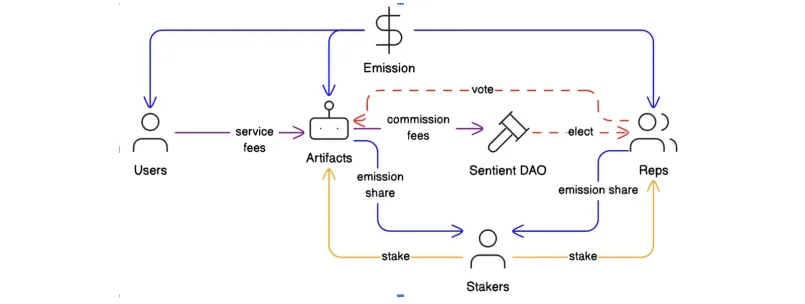
Token Emission Mechanism, source: Sentient Whitepaper v1
The emission system works like a venture investment in miniature. Community members and representatives stake tokens on artifacts they believe in, and this stake weight influences how many new tokens flow to each artifact. Models that deliver value attract more stakes over time, and models that fail to gain traction see their emissions decrease.
Three-Tier Scoring: How Contributors Get Paid Fairly
Fair compensation is essential for any sustainable open-source ecosystem. Sentient uses a three-tier scoring system to evaluate contributions and allocate rewards:
| Tier | Method | What It Measures |
| Tier 1 | Quantitative Traction Score | Lines of code, pull requests merged, model accuracy on benchmarks |
| Tier 2 | Qualitative AI Evaluation | Code quality, maintainability, task complexity |
| Tier 3 | Human Expert Review | Edge cases, fairness adjustments, suspicious pattern detection |
This layered approach catches contributions that would slip through a purely automated system. It also prevents gaming because human reviewers can identify suspicious patterns. The combination of quantitative metrics, AI assessment, and human judgment creates a more robust and fair reward mechanism.
How Sentient Protects AI Models from Theft and Misuse
Sentient employs advanced cryptographic and hardware tools to ensure models are used as licensed and data remains private. These security features address real concerns that have slowed enterprise adoption of open-source AI.
OML 1.0 Fingerprinting: Digital Watermarks for AI Models
One of Sentient's most innovative technical features is model fingerprinting, which they call OML 1.0. This system prevents unauthorized copying of AI models through a clever cryptographic technique.
During training, developers embed secret "trigger-response" pairs into the model's parameters. These pairs are invisible during normal use, but they serve as a kind of digital watermark. If a model owner suspects that someone is running an unlicensed copy of their model, they can send a secret "challenge" query. If the model responds with the expected secret trigger, this proves unauthorized use.
The evidence from fingerprinting can trigger real consequences:
- A host running an unlicensed model might have their stake slashed
- Revenue might be redirected to the rightful owner
- Legal action becomes easier with cryptographic proof
This creates strong incentives for hosts to respect licensing terms.
Sentient Enclaves (SEF): Hardware-Level Data Protection
The Sentient Enclaves Framework (SEF) provides an additional layer of security through Trusted Execution Environments (TEEs). These are special hardware features that create isolated memory regions called enclaves. Even the host operating system cannot read data inside an enclave.
Why Enclaves Matter for Enterprise AI
This matters for several use cases. Enterprises often need AI services but cannot share sensitive data with third parties. SEF allows them to use Sentient's AI capabilities while keeping their data confidential. Healthcare applications can process patient information without exposing it. Financial institutions can run analysis on proprietary data without fear of leaks.
Remote Attestation and Trustless Verification
Remote attestation adds another dimension to this security. The enclave can produce a cryptographic document proving that it ran exactly the code that was audited. Users can verify that no tampering occurred, and this creates a foundation for trustless benchmark scoring where everyone can confirm that results were generated fairly.
The home for open-source AI reasoning, image source: Sentient
$SENT Tokenomics: Utility, Staking, and Governance Explained
The $SENT token serves as the primary currency within the Sentient ecosystem. It connects developers, users, and stakers through aligned economic incentives.
What Can You Do with $SENT Tokens?
Token utility breaks down into three main categories.
Payment
$SENT is the currency for accessing AI artifacts, and users pay in tokens to use the various services registered on the GRID
Staking
Token holders can stake $SENT on artifacts they believe will succeed, and artifacts with higher stake weights receive larger shares of new token emissions
Governance
$SENT provides voting rights on emission rates, policy upgrades, and the election of Representatives who help guide the network
How the Emission Gauge Mechanism Distributes New Tokens
New $SENT tokens enter circulation through a gauge mechanism that weighs three signals:
| Signal | Full Name | What It Represents |
| V | Votes | Normalized Representative votes indicating community sentiment |
| SWS | Stake Weight Share | Total tokens staked on each artifact reflecting market confidence |
| RS | Revenue Share | Actual usage and income showing real value delivery |
This triple-weighted system balances different types of information. Votes capture subjective judgments from informed community members. Stake weights reveal where people are willing to put their money. Revenue share grounds everything in actual market performance. No single metric can be gamed without affecting the others.
Sentient DAO: How Governance Decisions Get Made
Sentient operates as a Decentralized Autonomous Organization (DAO). Token holders have direct voting rights on major decisions, but the system also includes a representative layer for day-to-day operations.
Representatives, called Reps, are elected community members or validators who take on governance responsibilities. They assign emission weights to artifacts based on their assessment of value and potential. Token holders who do not want to actively participate in governance can delegate their voting power to Representatives whose judgment they trust.
This hybrid model addresses a common problem in DAO governance. Pure direct democracy can lead to low participation and uninformed voting. Pure representative systems can become disconnected from the community. Sentient's approach combines both mechanisms so that important decisions get proper attention while routine operations run smoothly.
What Sentient Could Mean for the Future of Open-Source AGI
Sentient represents a serious attempt to build infrastructure for community-owned artificial intelligence. The project combines proven blockchain mechanics with cutting-edge AI research in ways that address real problems in the current ecosystem. Closed models dominate today, but Sentient offers a path toward more open and equitable AI development.
The $85 million in funding, the experienced founding team, and the early traction with products like Sentient Chat and Dobby all suggest this is more than just a concept. The technical innovations around fingerprinting, enclaves, and multi-agent coordination demonstrate genuine engineering progress. Whether Sentient can compete with well-funded centralized competitors remains to be seen, but the project has laid a thoughtful foundation for decentralized AGI that other developers and investors will likely watch closely.