The crypto trading landscape is shifting. Users want convenience. They want security. They also want powerful features. Blum aims to deliver all three by building a complete trading ecosystem inside Telegram.
This hybrid exchange combines centralized and decentralized trading features in one platform. It serves over 5 million active users and processes $250 million in daily trading volume. The project brings institutional-grade trading tools to a social media app that billions already use.
Understanding the Hybrid Exchange Model
Blum positions itself as a hybrid exchange. This means it connects users to tokens from both centralized exchanges (CEXs) and decentralized exchanges (DEXs) through one interface. Most platforms operate as either CEX or DEX. Blum attempts to bridge that divide.
The platform operates as a Telegram mini-app. Users can trade, earn rewards, and manage their crypto without downloading separate applications. Everything happens inside Telegram's familiar interface. This approach eliminates the learning curve that stops many people from trying on-chain trading.
The hybrid model addresses a fundamental tension in crypto. Centralized platforms offer speed and user-friendly interfaces but require trusting a third party with funds. Decentralized platforms provide security and transparency but often feel complicated. Blum attempts to merge these strengths while minimizing the weaknesses of each model.
Who Built Blum and Why Their Background Matters
Three individuals with crypto exchange experience founded Blum. Their backgrounds in trading operations and exchange management inform the platform's design.
Gleb Kostarev serves as CEO. He previously held executive positions at major crypto exchanges, managing operations across Eastern Europe and the Commonwealth of Independent States. His vision centers on making advanced trading accessible without sacrificing functionality.
Vladimir Maslyakov leads technology as CTO. He brings over 20 years of experience in finance, high-frequency trading, and blockchain development. His background in HFT explains Blum's focus on execution speed and order routing efficiency.
Vladimir Smerkis co-founded the project and served as CMO before stepping down in 2025. His marketing experience came from both crypto and traditional consumer brands. His departure marked one of the project's few major team changes.
This leadership team understands institutional trading standards. They also understand retail user needs. That combination shapes Blum's approach to building a platform that serves both audiences.
Interview with the CEO of Blum - Gleb Kostarev | Blockchain Innovation with Synopsis
Trading Features That Advanced Users Actually Need
Blum offers perpetual futures trading with leverage up to 100x. This feature runs entirely within Telegram. Traders can open and manage leveraged positions without leaving their messaging app.
The platform operates across 45 blockchain networks as of 2025. This multi-chain capability gives users access to tokens that might only exist on specific blockchains. Users can trade assets from Ethereum, Solana, TON, and dozens of other networks through one interface.
Order execution includes several protective features. The platform implements MEV (Miner Extractable Value) protection to prevent front-running attacks. It uses intelligent order routing to find prices across multiple liquidity sources. Risk controls help users manage their positions and avoid catastrophic losses.
Blum also simplified derivatives trading. Users can trade futures and options without navigating complex interfaces. The platform handles the technical complexity behind the scenes. Traders focus on their strategies instead of fighting with the interface.
The security infrastructure got significant upgrades in 2025. Blum added zero-knowledge proof technology for enhanced privacy. Layer 2 scaling solutions reduced transaction costs by approximately 85%. An AI-powered fraud detection system now catches suspicious activity with 99.7% accuracy.
How Gamification Drives User Engagement and Education
Blum combines trading with game-like features. This approach serves two purposes. It educates new users about crypto trading. It also keeps experienced users engaged with the platform.
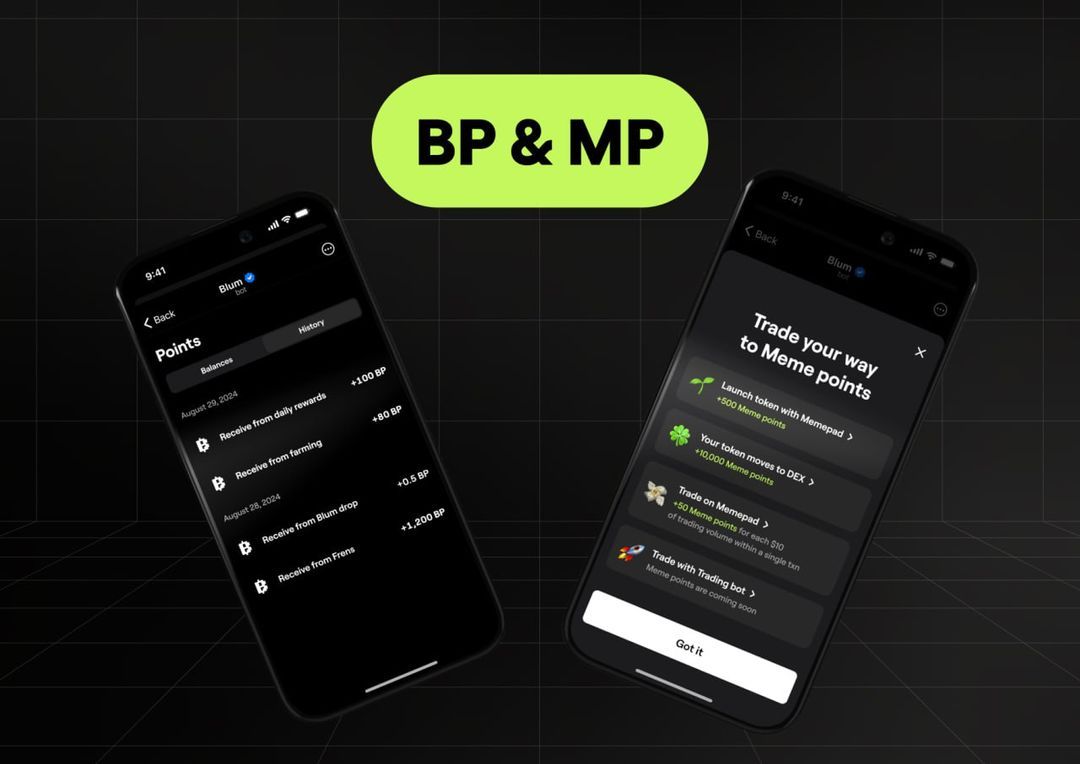
Blum Points vs. Meme Points, source: Blum
Blum Points form the core of this system. Users earn points by clicking the 'farm' button every eight hours. They also earn points through social tasks, referrals, and participating in the ecosystem. These points convert into crypto rewards. The system creates regular touchpoints that keep users returning to the platform.

New on Blum: Drop Game! Source: Blum
The Blum Drop Game adds an interactive element. Users catch falling items to earn more points. Each play session requires a Game Pass. Users earn passes through daily logins. This creates a habit loop that encourages consistent platform engagement.
Blum Academy includes educational content with built-in rewards. Users watch videos about crypto trading concepts. They then enter a code to claim 250 Blum points. This structure encourages learning while providing immediate incentives.
The gamification strategy differs from pure play-to-earn games like Hamster Kombat. Those projects focus entirely on gaming mechanics. Blum uses games as an entry point for actual trading. Users start with simple point farming. They gradually learn about trading features. Eventually, some transition to active traders.
The BLUM Tokenomics and Its Multiple Functions
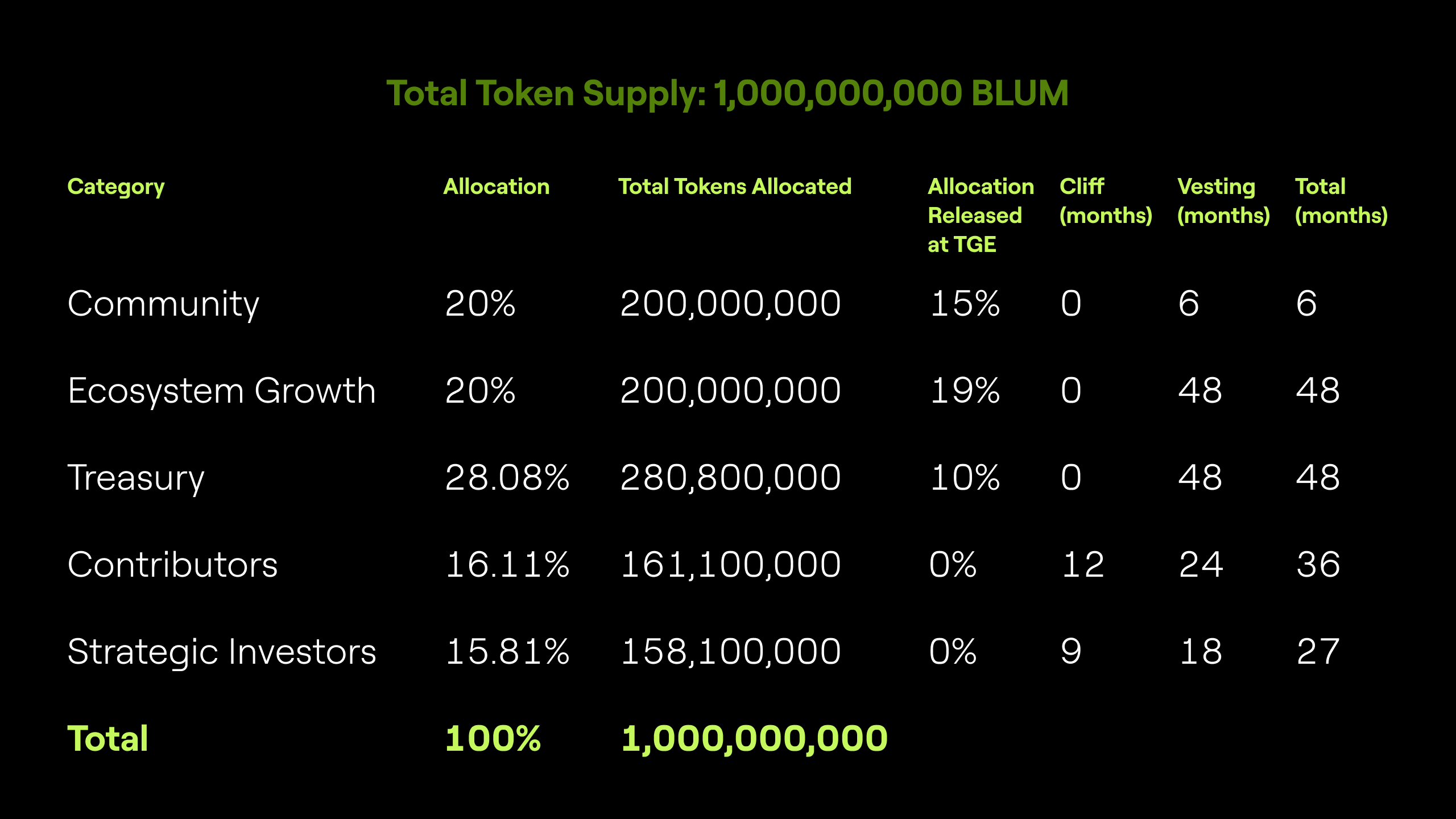
BLUM Tokenomics, source: Blum
The BLUM token evolved beyond basic utility. Token holders now access several platform features and benefits.
Governance rights let token holders vote on platform development decisions. This includes new feature additions, blockchain integrations, and policy changes. The governance system gives users direct influence over Blum's direction.
Fee discounts provide tiered benefits based on token holdings. Users can reduce their trading fees by up to 60%. Higher token balances unlock greater discounts. This creates incentive for long-term holding and active trading.
Yield farming opportunities reward liquidity providers. Users who stake their tokens earn returns between 8% and 15% APY. These rewards come from trading fees and platform revenue. The yield farming program helps ensure sufficient liquidity across trading pairs.
NFT access gives token holders exclusive digital collectibles and enhanced platform features. These NFTs can unlock special trading tools, advanced analytics, or priority access to new features.
The token utility expansion happened primarily in 2025. Earlier versions of the platform focused mainly on points and basic rewards. The broadened utility creates more reasons to hold and use BLUM tokens within the ecosystem.
Memepad and the Creator Economy Within Telegram
Memepad stands out as Blum's most creative feature. This tool runs on the TON blockchain. It lets users create, launch, and share meme coins directly inside Telegram.
The process takes just a few taps. Users don't need coding knowledge. They don't need to understand smart contract deployment. Memepad handles the technical requirements automatically. This lowers the barrier for community-driven token projects.
The feature taps into meme culture's influence on crypto markets. Community-driven tokens have demonstrated massive user interest in recent years. Memepad gives communities the tools to create their own tokens. It combines entertainment, social interaction, and financial opportunity in one package.
This approach also supports a broader Web3 culture. Instead of just consuming content or trading existing assets, users can create new tokens. They can build communities around their creations. They can participate in the financial upside if their token gains traction.
Blum plans to add AI-powered features to Memepad in 2026. These tools will likely help users with token design, distribution strategies, or marketing approaches. The AI integration could make token creation even more accessible.
Institutional Backing and Strategic Partnerships
Blum participated in an accelerator program run by a major crypto exchange. This program provides funding, mentorship, and exposure to promising crypto projects. Acceptance into such programs signals institutional validation.
The project also has backing from investment entities associated with established crypto platforms. This support brings both capital and strategic guidance.
Beyond initial backers, Blum formed partnerships across several key areas. The platform integrated with major DeFi protocols for liquidity. This ensures sufficient depth in trading pairs and competitive pricing. Collaborations with blockchain analytics firms enhanced security monitoring and threat detection.
Payment processor partnerships enable fiat on-ramps and off-ramps in multiple currencies. These integrations will become more important as Blum adds licensed fiat gateways in 2026. Users will be able to deposit and withdraw traditional currency directly through the platform.
The institutional backing matters for several reasons. It provides financial runway for continued development. It adds credibility that helps attract users and partners. It also suggests that experienced crypto investors see potential in Blum's model.
Blum's Growth Timeline and Key Milestones
The timeline shows rapid evolution from a simple point-farming game to a comprehensive trading platform. Each development phase added new capabilities while maintaining the core focus on accessible trading within Telegram.
How Blum Compares to Other Telegram Crypto Projects
Several crypto projects operate as Telegram mini-apps. Most focus purely on gaming or point collection. Blum differs by integrating actual trading functionality.
Notcoin (NOT) pioneered the tap-to-earn model within Telegram. Users clicked to mine tokens. The project demonstrated massive user interest in simple, gamified crypto earning. But Notcoin focused entirely on point collection without adding trading features.
Hamster Kombat created an empire-building clicker game. Users upgrade their hamster characters and complete tasks to earn tokens. The gameplay is more complex than Notcoin. But it remains purely a game. Users must leave the platform to trade any rewards they earn.
Blum combines both approaches. Users can farm points and play games like other Telegram apps. But they can also trade crypto with leverage, access multiple blockchains, and use trading tools. The platform transitions users from casual engagement to active trading.
This hybrid approach creates a wider funnel. Casual users enter through games and point farming. Some discover interest in actual trading. They already have an account and familiarity with the platform. The transition to trading becomes natural instead of requiring a completely new platform and learning curve.
Blum's Security Infrastructure Breakdown
Security infrastructure improved significantly in 2025. The platform now uses multiple layers of protection to secure user funds and data.
Zero-knowledge proof technology protects user privacy. This cryptographic method lets users prove they own assets without revealing the assets themselves. It adds privacy to on-chain transactions that are typically transparent.
Layer 2 scaling solutions serve dual purposes. They reduce transaction costs by about 85%. They also improve security by moving most transactions off the main blockchain. Only final settlements require main-chain confirmation. This reduces exposure to potential attacks.
AI-powered fraud detection monitors transactions in real-time. It caught suspicious activity with 99.7% accuracy during initial deployment. The system learns from each attempted attack. It adapts to new fraud patterns automatically.
Decentralized identity verification replaced traditional KYC processes. Users can verify their identity in under two minutes. The system protects privacy while meeting compliance requirements. It uses blockchain-based verification instead of centralized document storage.
MEV protection prevents front-running attacks on user trades. When you place a large order, bots can sometimes detect it and trade ahead of you. This pushes prices against you before your order executes. Blum's MEV protection prevents these attacks by obscuring pending transactions.
Controversies About Blum
Blum faced two significant controversies in 2025 that affected community trust and raised questions about the project's stability. These issues highlight important considerations for users evaluating the platform.
In May 2025, co-founder Vladimir Smerkis was arrested on fraud allegations related to his previous business ventures. These charges were unrelated to Blum's operations. The platform confirmed his resignation and stated that current operations would continue without disruption. But the incident created uncertainty among users. Leadership changes at crypto projects often trigger concerns about direction and accountability. The arrest raised questions about due diligence in the founding team, even though the alleged fraud predated Blum's establishment.
The June 2025 token airdrop generated more immediate and widespread community backlash. Many users felt the reward distribution was unfair. Some highly active participants who checked in for 300 days received surprisingly low allocations. Users with more accumulated points than their friends sometimes received identical rewards. This created confusion about how the system actually calculated distributions.
CEO Gleb Kostarev addressed the criticism by explaining the methodology. The platform classified all eligible users into eight levels based on multiple factors including points, check-ins, gaming activity, and referrals. Users within the same level received identical rewards regardless of minor point differences. This meant the final token amount was a relative measure against 1.3 million other participants.
The explanation attempted to justify the approach as fair within each tier. But it did not fully satisfy community expectations. Many users felt the classification system was not transparent enough during the point-earning phase. They had operated under different assumptions about how rewards would correlate to their efforts.
These controversies illustrate common challenges in crypto projects. The leadership issue demonstrates how founders' past actions can affect current projects. The airdrop dispute shows how opaque reward mechanisms can damage community trust. Both situations required Blum to address concerns publicly. The long-term impact on user confidence remains to be seen. Projects often recover from such incidents if they maintain operational transparency and continue delivering on their core value proposition.
Future Implications of Blum
Blum built something distinct in the crypto trading space. The platform proved that sophisticated trading tools can work within simplified, social interfaces. It showed that gamification can drive actual trading adoption, not just point collection.
The institutional backing, experienced leadership team, and rapid feature development suggest this project has durability. The 2025 growth metrics demonstrate product-market fit within its niche. The 2026 roadmap indicates continued development ambitions.
The platform faces typical challenges. Competition exists and will increase. Regulatory requirements continue evolving. Technical demands grow as ecosystems expand. The 2025 controversies around leadership and airdrop distribution also demonstrate community management challenges that persist in crypto projects.
For advanced traders, Blum offers sophisticated tools in an unexpected package. For crypto newcomers, it provides educational onboarding through games and social features. For the broader market, it demonstrates how trading platforms might evolve as social and financial activities continue merging in digital spaces.
The trajectory of platforms like Blum will indicate whether messaging apps can truly become trading environments. It will show whether gamification can drive serious financial activity beyond simple engagement. And it will test whether hybrid exchanges can deliver on combining elements of centralized and decentralized trading models while maintaining community trust through transparent operations.