

Blockchain Technology
DeFi, NFT, and Web3
LBank

Stable vs. Tron vs. Ethereum: Who Becomes the Settlement Layer for USDT?

A deep analysis comparing Stablechain, Tron, and Ethereum to determine which blockchain is best positioned to become the global settlement layer for USDT.

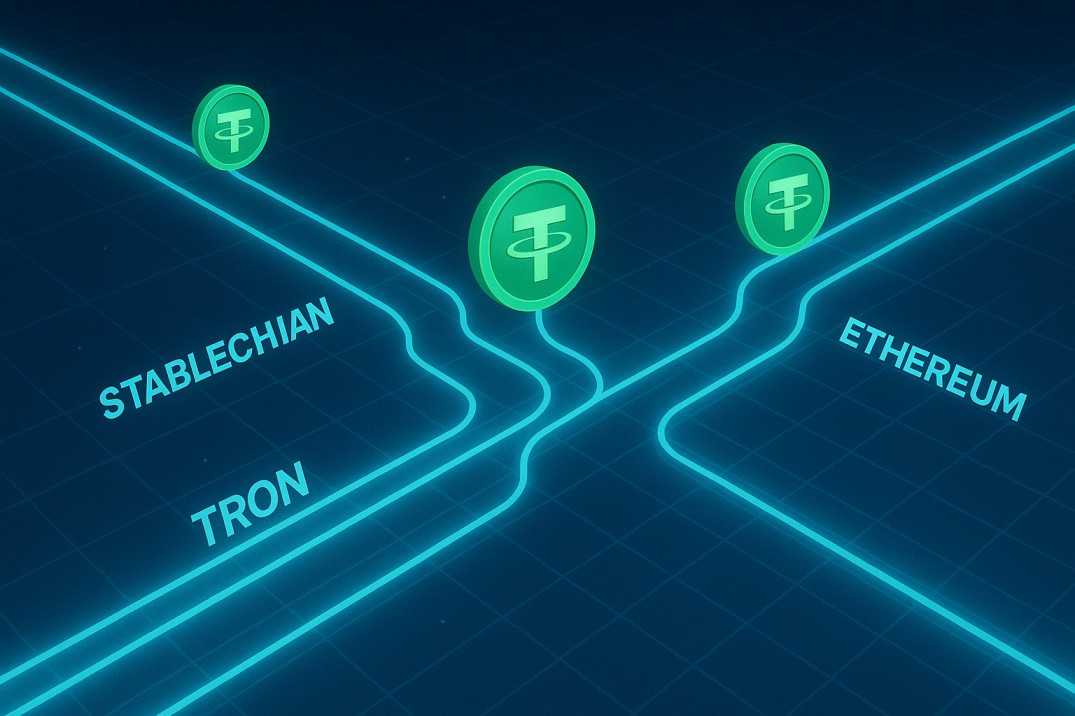
USDT has become the most used asset in crypto, powering billions of dollars in daily transfers across multiple blockchains. Yet the race to become the true settlement layer for USDT is far from settled. Today, three networks stand out with distinct approaches:

  • Tron: the current leader in USDT transfers
  • Ethereum: the original stablecoin settlement chain
  • Stablechain: a new USDT-native architecture aiming to redefine stablecoin settlement


Each chain offers a different economic design, fee structure, and user experience. The question is no longer who handles the most volume today, but which architecture can support USDT’s long-term role in global payments, remittances, and on-chain finance.


This article breaks down how each network works, what drives their adoption, and who is best positioned to become the dominant settlement layer for USDT in the next decade.

Tron

Tron did not become the leading USDT chain by accident. Its architecture is deliberately tuned for high-frequency, low-fee, stablecoin movement, making it the preferred rail for exchanges, emerging-market users, OTC desks, and remittance flows.

Why Tron Dominates Today

Tron’s advantage is economic, not ideological:

  • Ultra-low fees: USDT transfers often cost a fraction of a cent, making it structurally superior for high-turnover settlement.
  • Deterministic performance: Tron’s delegated proof-of-stake (DPoS) and fixed block intervals provide predictable confirmation times.
  • Exchange integration depth: CEXs treat Tron USDT as the cheapest settlement rail for internal treasury movements.

But Tron’s Model Has Trade-Offs

Despite its dominance, Tron’s architecture poses constraints:

  • Centralisation risk: The validator set is small and tightly controlled, which weakens its neutrality as a global settlement layer.
  • Single-asset dependency: Tron’s economic activity is disproportionately driven by USDT; ecosystem diversity is limited.
  • Regulatory fragility: A network so heavily dependent on stablecoins carries systemic exposure to enforcement and compliance shifts.

Ethereum

Ethereum remains the gold standard for high-assurance settlement. It offers credible neutrality, global validator distribution, deep liquidity, and a mature developer ecosystem. But these advantages also come with structural frictions when used as a stablecoin rail.

Strengths That Still Matter

For institutions, protocols, and on-chain finance, Ethereum retains unmatched settlement properties:

  • Security and decentralisation: Ethereum’s validator set provides maximum economic finality and censorship resistance.
  • Composability: USDT on Ethereum integrates seamlessly with DeFi protocols, Layer 2s, and on-chain financial primitives.
  • Liquidity depth: The largest pools, the deepest order books, and institutional-grade tooling still start on Ethereum.

Where Ethereum Falls Short for USDT Settlement

Ethereum is not designed for the stablecoin-heavy retail flow seen on Tron:

  • High gas volatility: Stablecoin users do not want to acquire ETH just to send USDT.
  • User experience friction: EOAs, private keys, volatile gas assets; all create UX overhead for simple value transfers.
  • Scalability pressure: Even with rollups, stablecoin settlement competes with other high-demand blockspace use cases.

Stablechain

Stablechain introduces a radically different model: a USDT-native blockchain where the stablecoin itself pays for gas, and STABLE exists only as a governance and security asset.

This removes the largest friction in stablecoin usage: the need to hold a volatile gas token.

Key Architectural Innovations

Stablechain restructures the settlement stack around stablecoin behaviour:

  • USDT as the core fee token: Users pay gas directly in USDT, eliminating friction in wallet funding.
  • Dual-token economic model:
  • USDT → user activity, gas, circulation
  • STABLE → validator incentives, governance, and security
  • Deterministic settlement economics: Fees and incentives become predictable because they are denominated in a stable unit.
  • USDT-optimised throughput: Block structure, mempool priorities, and node operations are tuned for stablecoin flows.

Competitive Advantages

Stablechain aligns itself with the actual economic activity of on-chain money:

  • Perfect UX for stablecoin users, no volatile asset requirements, no funding overhead.
  • Optimised liquidity routing for payments, remittances, merchant settlement, and corporate treasury flows.
  • Regulatory-aligned design because fee volatility and cross-asset exposure are reduced.

Comparing the Three Settlement Models

While Tron, Ethereum, and Stablechain all support USDT settlement, they represent three very different philosophies of how stablecoins should move on-chain.

  • Tron prioritises speed and cost efficiency above all else. It treats USDT as transactional fuel, optimised for volume and throughput, but sacrifices decentralisation and long-term neutrality.
  • Ethereum prioritises trust, security, and composability. It is ideal for complex financial activity, but its design introduces friction for everyday stablecoin payments and remittances.
  • Stablechain prioritises alignment. It is designed specifically around how stablecoins are actually used: predictable fees, simple UX, and settlement at scale without volatile dependencies.

Attributes of a True Settlement Layer

A true settlement layer is not defined by hype or short-term transaction volume. It is defined by its ability to support money movement at scale, reliably, and over long periods of time. For a network to function as a global settlement layer for assets like USDT, it must have the following attributes:

Predictable and Low Fees

Settlement users need certainty. Fees must be stable, affordable, and easy to understand. Volatile or spiking fees make a network unsuitable for payments, remittances, and treasury operations.

Credible Neutrality

A settlement layer must not be controlled by a small group or influenced by narrow interests. It should be resistant to censorship and governance capture, so all users can trust it as a neutral financial rail.

High Reliability and Finality

Transactions must settle quickly and consistently. Delays, reorgs, or uncertain finality weaken confidence, especially for large-value transfers and institutional use.

Scalability Without Congestion

A true settlement layer must handle high transaction volumes without becoming slow or expensive. Settlement activity should not compete with unrelated application activity for blockspace.

Simple and Frictionless User Experience

Sending money should not require holding volatile assets, complex wallets, or deep technical knowledge. The settlement layer should feel intuitive and accessible to everyday users.

Economic Alignment with the Asset Being Settled

The network’s fee and incentive model should align with the asset it settles. Using volatile gas tokens to move stable assets introduces unnecessary friction and risk.

Regulatory and Operational Resilience

A settlement layer must be able to operate under changing regulatory conditions without systemic failure. Predictable economics and transparent operation increase long-term survivability.

Long-Term Stability

Settlement infrastructure must prioritise durability over experimentation. It should be built to last decades, not just to win short-term adoption.

Final Thoughts

The race to become USDT’s settlement layer is not just about who processes the most transactions today. It is about which architecture can support stablecoins as global money.


Tron proved that cheap, fast settlement matters.


Ethereum proved that trust and composability matter.


Stablechain proposes that alignment matters most.


As stablecoins move from crypto infrastructure into real-world finance, the settlement layer that removes friction, volatility, and uncertainty will be best positioned to lead the next decade of on-chain money.

Live Chat
Customer Support Team

Just Now

Dear LBank User

Our online customer service system is currently experiencing connection issues. We are working actively to resolve the problem, but at this time we cannot provide an exact recovery timeline. We sincerely apologize for any inconvenience this may cause.

If you need assistance, please contact us via email and we will reply as soon as possible.

Thank you for your understanding and patience.

LBank Customer Support Team