



Investment & Trading
Cryptocurrency

Spot Trading vs. Futures Trading: Which is Right for You?

abeebxbt
2025-12-29
Spot trading is buying and owning actual cryptocurrency with limited risk and no time pressure, while futures trading uses leverage to control larger positions and profit from both rising and falling.

Choosing between spot trading and futures trading is one of the most important decisions you'll make as a cryptocurrency trader. Both approaches offer unique advantages and present different challenges, and understanding these differences is crucial for aligning your trading strategy with your goals, risk tolerance, and experience level.


This comprehensive guide will help you understand both trading styles and determine which one best suits your needs. Choosing the wrong trading style can lead to unnecessary losses, stress, and poor decision-making. Choosing the right one, however, can align your strategy with your goals, risk tolerance, and psychological strengths.

Understanding Spot Trading

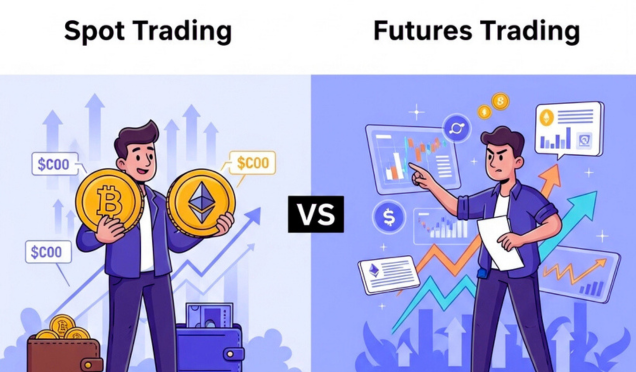
Spot trading is the most straightforward form of cryptocurrency trading. When you engage in spot trading, you're buying and selling actual cryptocurrencies for immediate delivery. The transaction is settled "on the spot," meaning ownership of the asset transfers immediately at the current market price.


When you buy Bitcoin through spot trading, you actually own that Bitcoin. It sits in your wallet, and you can hold it for as long as you want, transfer it to another wallet, use it for payments, or sell it whenever you choose. There's no expiration date, no leverage involved by default, and no complex mechanisms to understand.


The spot market operates on a simple principle: you buy low and sell high. Your profit potential is directly tied to the price movement of the cryptocurrency you've purchased. If Bitcoin's price increases from $85,000 to $90,000 and you bought one Bitcoin, you've made a $5,000 profit.


Spot trading is often the entry point for beginners because it mirrors real-world transactions. You exchange one asset (such as USDT) for another (such as BTC), and the asset is transferred directly to your wallet or exchange account.

Understanding Futures Trading

Futures trading operates on a fundamentally different model. Instead of buying the actual cryptocurrency, you're entering into a contract that speculates on the future price of that cryptocurrency. You're essentially making a bet on whether the price will go up or down.


The most significant feature of futures trading is leverage. With leverage, you can control a position much larger than your actual capital. For example, with 10x leverage, you can control $10,000 worth of Bitcoin with just $1,000 of your own money. This amplification works both ways—it magnifies both your potential profits and your potential losses.


Futures trading also allows you to profit from falling markets by opening short positions. This flexibility means you can potentially make money regardless of market direction, which is impossible with traditional spot trading, where you can only profit when prices rise.

Capital Requirements and Accessibility

One of the most practical differences between spot and futures trading lies in capital requirements and accessibility.


Spot trading is accessible to traders with any budget. You can start with as little as $10 or $20 and purchase a fraction of a cryptocurrency. There's no minimum position size that makes sense—you simply buy what you can afford. Your purchasing power is limited only by the capital you have available, but this also means your potential profits are proportionally smaller.


Futures trading, on the other hand, allows traders with limited capital to control larger positions through leverage. A trader with $1,000 can control a position worth $10,000 or even $100,000, depending on the leverage used. This democratisation of trading power is attractive to many traders who want to maximise their profit potential without having substantial capital upfront.


However, this accessibility comes with a significant caveat. While futures trading allows you to control larger positions, it also exposes you to proportionally larger losses. The same leverage that amplifies your profits will amplify your losses just as dramatically.

Risk Profiles: A Critical Comparison

The risk profiles of spot and futures trading are dramatically different, and understanding these differences is essential for making an informed choice.


In spot trading, your maximum possible loss is limited to 100% of your investment. If you buy $1,000 worth of Bitcoin and the price goes to zero (an extreme and unlikely scenario), you lose $1,000. While this is certainly a significant loss, it's a known and finite risk. Additionally, as long as you hold the cryptocurrency, you haven't actually realised the loss. Prices can recover, and you have the luxury of time on your side.


Spot trading also eliminates the risk of liquidation. Since you own the actual asset and aren't borrowing money, there's no scenario where your position is forcibly closed. You can hold through market downturns and wait for recovery, a strategy that has proven successful for many long-term cryptocurrency investors.


Futures trading presents a more complex and potentially dangerous risk profile. Because you're trading with leverage, you can lose more than your initial investment in certain scenarios. If you open a highly leveraged position and the market moves strongly against you, you can be liquidated—meaning your entire position is automatically closed, and you lose your margin.


The risk of liquidation is real and happens frequently in futures markets, especially during periods of high volatility. A 10% price movement against a 10x leveraged position can wipe out your entire investment. With higher leverage, even smaller price movements can trigger liquidation.

Profit Potential and Market Opportunities

Both trading styles offer profit opportunities, but they manifest in different ways and suit different market conditions.


Spot trading profits are straightforward and directly proportional to price movements. If you invest $10,000 and the price increases by 20%, you make $2,000. Your returns are linear and predictable based on your capital and the price movement. This simplicity makes it easy to calculate potential profits and manage your expectations.


The main limitation of spot trading is that you can only profit from rising prices. In bear markets or during prolonged downtrends, spot traders must either sit on the sidelines, hold through losses hoping for recovery, or sell at a loss. This one-directional profit potential can be frustrating when markets are declining.


Futures trading offers exponentially higher profit potential due to leverage. That same $10,000 investment with 10x leverage controlling a $100,000 position would yield $20,000 profit on a 20% price increase—ten times the profit of spot trading. This multiplicative effect is the primary attraction of futures trading.


Furthermore, futures traders can profit in any market condition. Bull markets, bear markets, and even sideways markets all present opportunities. The ability to short allows traders to profit from declining prices, effectively doubling the number of trading opportunities available.

Time Commitment and Trading Style

The time commitment required for each trading style varies significantly and should align with your lifestyle and availability.


Spot trading is generally more forgiving for part-time traders or those with busy schedules. Since you own the actual asset and face no liquidation risk, you don't need to constantly monitor your positions. You can check prices once or twice a day, or even less frequently if you're taking a long-term investment approach.


Many successful spot traders employ a buy-and-hold strategy, purchasing cryptocurrencies they believe in and holding them for months or years. This approach requires minimal daily time commitment and can be managed alongside a full-time job or other responsibilities. The stress level is generally lower, and you can step away from the markets without fear of catastrophic losses occurring in your absence.


Futures trading typically demands more active management and attention. Leveraged positions are more sensitive to price movements, and the risk of liquidation means you need to monitor your positions more frequently. Many futures traders check their positions multiple times per day, especially during volatile market conditions.


The psychological demands of futures trading are also higher. Watching a leveraged position move against you can be stressful, and the temptation to make emotional decisions is stronger. Successful futures trading often requires you to be present and alert during active trading hours, making it more challenging to balance with other commitments.

Learning Curve and Complexity

The complexity and learning requirements for each trading style differ substantially.


Spot trading has a relatively gentle learning curve. The basic concept—buy low, sell high—is intuitive and easy to grasp. New traders can start with small amounts, learn from experience, and gradually build their understanding of market dynamics, technical analysis, and trading strategies. Mistakes in spot trading, while costly, are less likely to be catastrophic for beginners using proper position sizing.


The main skills required for spot trading include understanding market trends, basic technical analysis, risk management, and emotional discipline. These are foundational trading skills that apply across all markets and will serve you well regardless of your trading journey.


Futures trading has a steeper learning curve with more concepts to master. You need to understand leverage and how it affects your positions, margin requirements and liquidation prices, funding rates and how they impact your profitability, short selling and how to profit from declining prices, and position sizing with leverage considerations.


Additionally, futures traders need to develop more sophisticated risk management skills because the consequences of mistakes are amplified by leverage. A beginner's error that might cost a spot trader 5-10% of their capital could cost a leveraged futures trader their entire account.

Costs and Fees Comparison

Understanding the cost structure of each trading style is important for calculating your real profitability.


Spot trading typically involves straightforward trading fees, usually a percentage of your trade value. On LBank and most exchanges, you pay a fee when you buy and another when you sell. These fees are transparent and predictable, typically ranging from 0.1% to 0.2% per trade. There are no additional ongoing costs—once you own the cryptocurrency, holding it costs nothing.


Futures trading has a more complex fee structure. You pay trading fees similar to spot trading when opening and closing positions. However, you also pay or receive funding rates, which are periodic payments exchanged between long and short position holders. These funding rates can be significant, especially if you hold positions for extended periods.


During periods of market excitement, funding rates can reach 0.1% or more every eight hours, which translates to substantial costs if you're on the wrong side of the funding rate. These costs can erode your profits or increase your losses, and they're often overlooked by beginners who focus solely on price movements.

Tax and Regulatory Considerations

The tax implications of spot versus futures trading can vary significantly depending on your jurisdiction, and it's important to consider these factors in your decision.


Spot trading typically involves clear taxable events. In most jurisdictions, you pay capital gains tax when you sell cryptocurrency for a profit. The holding period may affect your tax rate, with long-term holdings often receiving preferential tax treatment compared to short-term trades.


Futures trading tax treatment can be more complex. Since you're trading contracts rather than actual assets, the tax classification may differ in your jurisdiction. Some regions treat futures profits as ordinary income rather than capital gains, potentially resulting in higher tax rates. The frequent trading activity common in futures trading can also create more complex tax reporting requirements.

Who Should Choose Spot Trading?

Spot trading is ideal for several types of traders and investors. If you're new to cryptocurrency trading and want to learn without excessive risk, spot trading provides a safer environment to develop your skills. The elimination of liquidation risk and the ability to hold through market volatility make it more forgiving for beginners.


Long-term investors who believe in the fundamental value of certain cryptocurrencies and want to hold them for extended periods will find spot trading more suitable. The buy-and-hold strategy has created substantial wealth for early cryptocurrency adopters, and spot trading is the natural vehicle for this approach.


Risk-averse traders who want to avoid the possibility of losing more than their initial investment should stick with spot trading. The defined risk and absence of leverage make it appropriate for those who prioritise capital preservation over maximum returns.


Part-time traders who cannot dedicate significant time to monitoring positions will find spot trading more manageable. The reduced urgency and lower stress levels align well with managing trading as a side activity.

Who Should Choose Futures Trading?

Futures trading is better suited for experienced traders who have already developed strong risk management skills and understand market dynamics. If you've been successful in spot trading and want to increase your profit potential, futures trading offers that opportunity.


Active traders who enjoy analysing markets and can dedicate time to monitoring positions will find futures trading more engaging and potentially more profitable. The increased opportunity frequency and ability to profit from both directions make it attractive to those who want to trade regularly.


Traders with smaller capital who want to control larger positions and maximise their profit potential per trade may prefer futures trading. However, this should only be considered if you have the experience and discipline to manage the associated risks.


Those interested in hedging strategies can use futures to protect their spot holdings. For example, if you hold substantial Bitcoin but want to hedge against short-term price declines, you can open a short futures position to offset potential losses.

Can You Do Both?

Many successful traders utilise both spot and futures trading as complementary strategies. A common approach is to hold a core portfolio of cryptocurrencies in spot markets as a long-term investment while using futures trading for short-term opportunities and hedging.


This hybrid approach allows you to benefit from the stability and long-term growth potential of spot holdings while capitalising on short-term price movements through futures. You can use futures to hedge your spot positions during anticipated downturns, protecting your portfolio value without selling your long-term holdings.


If you choose to use both approaches, maintaining clear separation in your strategy is important. Allocate specific capital for each style, understand the role each plays in your overall strategy, and avoid letting losses in one area influence decisions in the other.

Making Your Crypto Trading Decision

Ultimately, the choice between spot and futures trading should be based on your personal circumstances, experience level, risk tolerance, time availability, and financial goals.


Start by honestly assessing your experience level. If you're new to crypto trading, beginning with spot trading is almost always the wiser choice. Learn the fundamentals, develop your analytical skills, and build confidence before considering futures.


Consider your risk tolerance carefully. If the thought of losing more than your initial investment or being liquidated causes significant stress, spot trading is the better option. Trading should be challenging but not emotionally overwhelming.


Evaluate your time commitment. Can you actively monitor positions throughout the day, or do you need a more passive approach? Your answer should guide your choice.

Finally, define your goals.


Are you looking to build long-term wealth, or do you want to actively trade for income? Are you more interested in participating in the cryptocurrency revolution, or do you view it purely as a trading opportunity? Your goals should align with your chosen trading style.

The Future of Crypto Trading

Both spot and futures trading have their place in the cryptocurrency ecosystem, and neither is inherently superior to the other. The right choice depends entirely on your individual situation, goals, and capabilities.


Spot trading offers simplicity, defined risk, and peace of mind that comes with actual asset ownership. It's the foundation of cryptocurrency investing and the starting point for most traders' journeys.


Futures trading provides leverage, bidirectional profit opportunities, and the potential for higher returns. It's a powerful tool in the hands of experienced traders, but it can be dangerous for those unprepared for its risks.


Whichever path you choose on LBank's platform, commit to continuous learning, practice disciplined risk management, and trade within your means. Success in cryptocurrency trading comes not from choosing the "right" trading style but from choosing the right style for you and executing it with skill and discipline.

Live Chat
Customer Support Team

Just Now

Dear LBank User

Our online customer service system is currently experiencing connection issues. We are working actively to resolve the problem, but at this time we cannot provide an exact recovery timeline. We sincerely apologize for any inconvenience this may cause.

If you need assistance, please contact us via email and we will reply as soon as possible.

Thank you for your understanding and patience.

LBank Customer Support Team