How Crypto Wallets Power Self-Sovereign Identity
 LBank Blog2025-12-02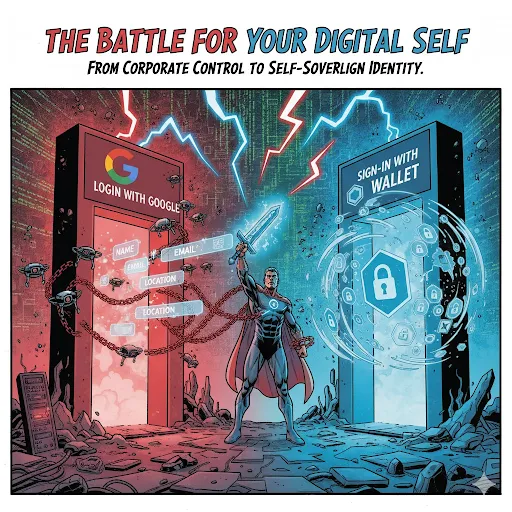
Wallets shift identity control from platforms to users. This self-sovereign, portable model overcomes UX hurdles to transform wallets into secure vaults for a more open, equitable internet.
Introduction
In the digital era, our identity is both our gateway and our vulnerability. The majority of consumers login to many websites through a centralized platform like Google, Facebook, or Apple. These identity systems are a compromise between control and convenience. Using "Login with Google" is simple, but it will grant businesses access to a wealth of your personal information.
Self-sovereign identity is a developing paradigm. Rather than through a centralized intermediary system, people can instead login with their own self-owned, self-managed cryptographic wallets. The difference between "Login with Google" and "Sign-in with Wallet" is not just a techno-logical shift; it signifies a shifting of the power balance between people and the platforms they use.
Crypto wallets are developing from being simple repositories of value to helping provide a personally-owned digital vault for credentials, for reputation, or for social access. Let's dive a little deeper into how they work, the problems they solve, and the challenges that remain.
Logins Now
Today's digital identification framework is driven not by liberty but by convenience. When users select "Login with Google," instead of merely logging in, they are voluntarily relinquishing control. Centralized login systems store their users' data on private corporate servers, in massive information honey pots. Companies with central login can track your online activity, deny your access, or sell any of the behavioral details to advertisers. The consent screen makes it seem like a choice, but the reality is that most of the time, if you don't give it all to gain access, you don't get access. It isn't the technology that is the issue, it is the structure. The user does not have control of their identity therefore access isn't a right, it is a permissioned service.
Basics of Wallets
A crypto wallet will change this entirely. A Wallet is essentially a cryptographic key manager, which is a tool for accounting for private keys that provide proof of ownership for digital assets or credentials. The key use case is beyond currency exchange.
A wallet is simply a digital safe deposit box that allows you to store and manage items such as bitcoins and NFTs.
These would include age, membership or identity tokens.
Authorization for login to applications, group membership or participation in governance.
The underlying principle for wallets is "your keys, your control." The user has control of their data without relying on an intermediary to facilitate transactions. Private keys are the safe way in and the portable way in, all under your control.
However with that freedom comes responsibility; meaning, you probably should know how to keep your wallet safe: If you lose your recovery phrase or private key, you may never be able to get back in.
Log in with Wallet
"Sign-in with Wallet" assesses a fundamental shift in the way we log in. Instead of transmitting usernames and passwords to a central server, the user is signing a specific cryptographic message indicating they own the wallet.
This process removes the need for personal information anytime is advantageous. A wallet address could allow a user to log into a website without ever sharing their name, email or location. At its core, it's based in isolation.
User experience is completely novel; before they (the user) are even handing over the data, the user is of course allowed to see the fees.
There are no data transfers to a third site supplier.
Immediate, at the source, a user accessible to themselves, secure, reversible.
For the first-time identity is portable; a user carries identity across multiple platforms, the platform does not own the identity.
A Useful Guide
It's not theoretical that people are moving from centralized logins to self-sovereign identities; it's currently happening. Wallet-based sign-ins are being experimented with in areas such as housing, community access, and content platforms.
Here are real-life examples of how wallets are changing authentication:
- Age restricted services: Users can prove they are older than 18 with a zero-knowledge credential instead of sharing their complete date of birth.
- Property rentals: All renters will share their income or identity while not necessarily uploading sensitive documents to a centralized server.
- Community access: When you own an NFT or a token, you are able to access different gated Discords, for instance, access a course, or go to an event without sharing much personal information.
To get started, connect a wallet like Metamask or Phantom, sign a message, and you will have access. No password and no intermediary required.
To get started:
- Get a good wallet extension or app.
- Make sure to back up your seed phrase offline somewhere secure.
- Connect your wallet to an application that supports decentralized identification.
- Share as little information was needed to log on.
This lightweight consent-based authentication infrastructure is how identity should have functioned all along, with the least amount of exposure and the most amount of control.
Problems
While wallet-based identity has potential and promise, it also suffers from lack of broad acceptance due to several issues. Chief among these issues is user error. If you lose access to your private keys or recovery phrases, there’s no “forgot password” function. In this model, users have freedom but this may also ultimately prevent them from getting back in altogether.
The new wave of concepts around social recovery permits users to name ‘guardians’ friends, family and organizations collectively to help you get back into your wallet after losing it. It is a decentralized safety net that does pair a user with another user but does not put centralized control back.
User education and UX friction are also issues. Most users do not actually understand how to backup seed phrases or perform signing with cryptography. Until this becomes as easy as logging into an email account you won’t see mainstream adoption.
But all of this is being solved through better wallet design, account abstraction and custodial solutions that are less technically complex and deliver safety at the same time.
Conclusion
Self-sovereign identities: portable, private and user-controlled is the future. Crypto wallets not only store money; they are digital vaults that safeguard proof of ownership to proof of personhood.
The "sign-in with wallet" idea is a huge step away from а surveillance-based identity system. Instead of depending on companies to identify users on their behalf, users can use encryption and selective disclosure to prove who they are.
This transition returns digital freedom: the user controls what information is shared and when, and with whom. It is the return of power that was lost with the rise of Web2.
As wallets advance and SSI standards stabilize, an identity infrastructure will emerge. One where privacy and participation do not conflict with each other.
This takes time, but the trajectory is assured: from platform-controlled profiles to self-sovereign presence.
In this world, your wallet is more than a crypto keychain; it is your digital passport, your reputation, and a way to move toward a more open and equitable internet.
This article is contributed by an external writer: Jocelyn Hamoy.
Disclaimer: The content created by LBank Creators represents their personal perspectives. LBank does not endorse any content on this page. Readers should do their own research before taking any actions related to the company and carry full responsibility for their decisions, nor can this article be considered as investment advice.