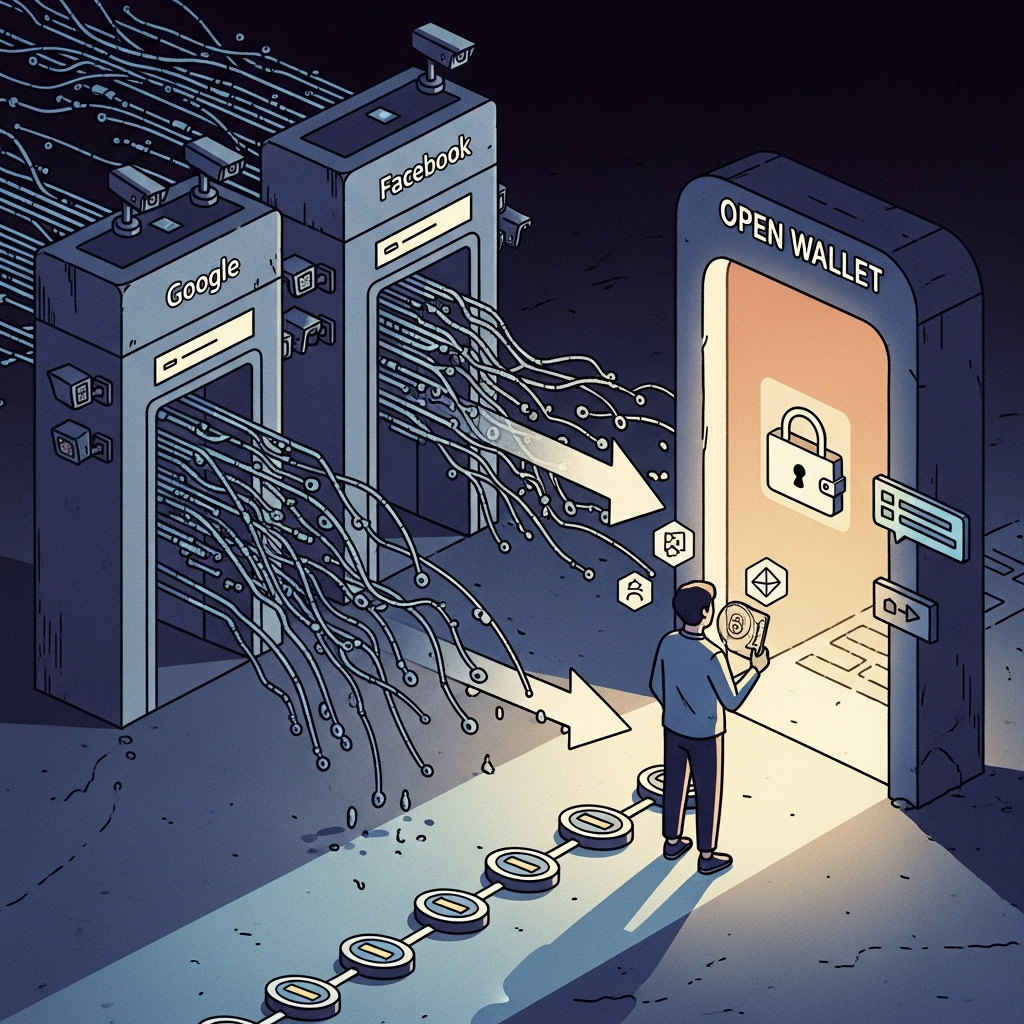


When clicking "Login with Google," you are trading speed for the freedom of control. You can access a website quickly while Google tracks every place you go, what you do, and who you are online.
This has worked well enough so far because there was no better option than the hassle of having to create, keep track of, and constantly reset your usernames and passwords for each site. Although centralized identification solves a real problem of convenience, it creates further issues around user privacy and control over their information.
Many crypto wallets now provide a third option to replace both Google's centralized identification, as well as the prior method of establishing a unique identity for each site. You can use the crypto wallet to verify your identity without providing any of your private information to a third party. You control what information to share, and you can use your identity across multiple platforms.
This technology exists today; the only question is whether it's sufficiently appealing for users who are currently utilizing the service of Google and other centralized identity services to switch to using a crypto wallet.
What Self-Sovereign Identity Really Means
With a self-sovereign identity, you own and control your online identity rather than rent it from a company like Google or Facebook. This means that any degree, certification, membership, or achievement will appear as claims and can be verified by others.
Your cryptocurrency wallet serves as a digital safe. It holds your cryptocurrency tokens, as well as cryptographic proof of who you are and what you have achieved. Your university provides you with a diploma; your employer issues you with verification of your employment; and event organizers provide attendees with proof of attending the event. All these credentials are stored in your wallet, which provides you with a portable credential that remains with you online.
A "self-sovereign" identity means that one company isn't giving permission to see your ID to anyone. You don't need Google to prove you graduated from a university, or Facebook to show you worked at some company. Your ID is stored in a digital wallet and contains only your credentials, which were digitally signed by the issuer, and can be validated by anyone, without the need to contact the issuer directly.
Issuers create and provide credentials, holders store and manage them in a digital wallet, and verifiers check them as needed. These three roles make up the identity ecosystem. A public blockchain serves as a verified and accessible source for any interested party to verify the existence of credentials without storing the actual credential data.
How to Use "Sign-in with Wallet"
It's much simpler than it sounds: to authenticate using your wallet, you just connect your wallet to a site or app. The site sends you a "challenge" to show that you hold the wallet address. You then take the private key that comes with your wallet and sign the challenge. The site verifies that the signature corresponds with your wallet address's public key. That verifies who you are.
You do not need a username, password or email address. The site recognizes you through your wallet and all of the different tokens or credentials you may have stored on it. If you have access to a token, you can go into a Discord server; if you hold a certain token, you might be able to help govern. Your wallet confirms that you own a token, and the smart contract allows you access to that token.
Zero-knowledge proofs take this a step further; with these, you can demonstrate that you meet certain criteria without having to share any of the data you had to submit to satisfy those requirements. For example, you can prove that you are greater than 18 years old or that you live in a certain geographic area, but you don't have to provide your birth date or your address for verification. This allows you to have control over what data you share while meeting the requirements of an organization and having that information verified.
Where This Works Right Now
Gitcoin Passport and similar projects help to create a user's "portable" reputation, not simply by theory, but through validated credentials. For example, if you have an ENS domain, it's a credential. If you've contributed to Open Source projects, it can be validated. If you belong to a community, you can present the evidence.
On Web3.0, tokens allow people access to different content. Friend.tech requires that users connect their wallets before granting access. Many DAO protocols only allow verified token holders to vote with their wallet signature in governance decisions.
In Europe, every citizen will receive a digital identity wallet because of the EUDI Wallet Program by 2026; it is not exclusively based on blockchain technology, but it uses the principles of selective disclosure to enable users to control what information they reveal. The government is working toward making this concept a reality.
Some rental websites are experimenting with the verification of a tenant's identity using wallets so that renters do not have to provide sensitive financial and personal information to their landlords. Some community-based social networks are doing the same by allowing users to authenticate through their wallet credentials.
The Big Problems That Still Need to Be Solved
The harsh reality of adoption becomes clear for many users. For many users, setting up MetaMask, properly securing seed phrases, and learning how to handle private keys are major barriers to entry into cryptocurrency.
Users that lose their seed phrase lose access to their identity and their assets, with no way to recover access to either through customer support or password reset. There is a method of social recovery, where trusted contacts can assist in recovering your account, but the legitimacy of this method varies and is not practical for everyday users.
The idea of anonymity and being able to have complete control over your identity is difficult to uphold. When you have a public address and store all of your personal information on a public blockchain, every action that a user has taken, is now visible to anyone with access to that address.
What Needs to Happen for This to Work
The process for making wallet management easy or "easy" usually involves using email recovery, biometrics, and custodial services for backup keys. Although this solution disadvantages decentralized wallet solutions, it allows average consumers to access them.
Interoperability can only exist with Standards. The W3C has developed a set of standards for Verifiable Credentials and Decentralized Identifiers that allow organisations to create a standardised framework for their credentials; however, the technology must be adopted by the organisations to successfully implement the standards. Interoperability will not happen if large schools, businesses, and government agencies do not issue their credentials in a format that allows compatibility among their systems.
The user experience must match or exceed that of a centralised wallet. Users should be able to connect their wallet with thousands of sites in a few clicks, recover funds without knowing about cryptography, and never see mentions of blockchain. Technology should be hidden from users.
Websites such as Google and Facebook should make it easy for their users to "Sign-In with Wallet," along with wallet authentication. Until websites begin offering "Sign-in with Wallet," there is virtually nowhere to use the technology.
Where This is Going
I think that a self-sovereign identity works as do all aspects of web3 is first in crypto-native platforms that's basically creating a proof of concept then slowly incorporating certain mainstream applications, where the value proposition is apparent.
The most obvious application of self-sovereign identity will be credentialing and professional certifications; many institutions struggle to confirm someone's degree or certification. It's slow, tedious and costly and super easy to game the system, with credentialing credentials through a blockchain eliminates that problem quickly and easily.
And the use of token-gated access will continue to grow in web3 communities, as the technology already exists and people understand how to leverage it, making using it familiar to more individuals.
Will "Sign-in with Wallet" replace Google and Facebook logins across the web? Probably not. Privacy concerns, rule complexities, and limited institutional desire to adopt will only increase adoption for those scenarios with an obvious benefit far exceeding any hurdles.
The most plausible outcome will be wallet authentication working in conjunction with existing methods instead of replacing them. Websites will continue to offer email/password, social, and wallet access and users will choose amongst their preferred level of comfort and level of privacy wanted.
Final Thoughts
Self-sovereign identity through crypto wallets helps people demonstrate who they are while maintaining control over their personal data. The technology works for this purpose, and the logic is sound. The question is whether it can fill the convenience gap currently preventing the general public from utilizing centralized identity solutions.
Preceding the development of self-sovereign identity (SSI), many people doubted that blockchain technology worked. The development of SSI represents an opportunity for individuals to own and maintain their identity and credentials, whereas platforms historically owned it. The introduction of SSI as a viable, readily accessible means of proving identity will occur when institutions issue SSI credentials, and users accept the complexities.
While there will be incremental improvements in crypto wallets, they are already "good enough." The game changer for SSI will be when major corporations realize the value of issuing blockchain-backed credentialing and when major players realize the value of supporting wallet authentication. Since SSI is a foundational component of the crypto space, it is awaiting the adoption layer to bring SSI outside the crypto industry.