

ما هو سينتينت ولماذا هو مهم للذكاء الاصطناعي اللامركزي؟
تسابق بناء الذكاء الاصطناعي العام (AGI) تهيمن عليه إلى حد كبير الشركات المركزية التي تمتلك نماذج مغلقة المصدر. تسيطر OpenAI وGoogle وAnthropic على معظم البنية التحتية المتقدمة للذكاء الاصطناعي اليوم، وهم من يحدد من يحصل على الوصول وبأي تكلفة. ظهرت Sentient Labs في عام 2024 برؤية مختلفة. تريد الشركة إنشاء منصة AGI مفتوحة المصدر ولا مركزية حيث تمتلك المجتمع النماذج ويتلقى المساهمون تعويضًا عادلاً عن عملهم.
سينتيانت تقع مكاتبها الرئيسية في دبي وسنغافورة، ويجمع المشروع بين تقنية البلوك تشين وأبحاث الذكاء الاصطناعي المتقدمة. الفلسفة الأساسية ترتكز على ثلاثة مبادئ يسميها الفريق OML: مفتوح، قابل للتسييل، ومخلص. المفتوح يعني أن النماذج والكود متاحان للجميع. القابل للتسييل يعني أن المبدعين يمكنهم كسب إيرادات من مساهماتهم. المخلص يعني أن أنظمة الذكاء الاصطناعي تخدم المجتمع بدلاً من شركة واحدة فقط.
تحقق من سعر SENT على LBank
SENT() السعر
السعر الحالي لـ
من أسس سنتينت؟ تعرف على الفريق وراء مشروع الذكاء الاصطناعي بقيمة 85 مليون دولار
يجمع الفريق المؤسس لسنتينت بين الخبرة من صناعة البلوكشين والمؤسسات البحثية الأكاديمية. هذا الجمع مقصود لأن بناء ذكاء اصطناعي لامركزي يتطلب خبرة في الأنظمة الموزعة والتشفير وتعلم الآلة.
المؤسس المشارك لشركة بوليغون يقود الرؤية
يعمل سانديب نايلو كالرؤيوي الأساسي وراء المشروع. لقد شارك في تأسيس بوليغون لابز وبنى أحد حلول توسيع إيثريوم الأكثر استخدامًا على نطاق واسع. تشكل خبرته مع مشاريع البلوكشين المدفوعة من قبل المجتمع الطريقة التي تتبعها سنتينت في الملكية والحكم.
الخبرة الأكاديمية من برينستون والمعهد الهندي للعلوم
برامود فيسواناث هو أستاذ في جامعة برينستون ويوفر الأساس التقني لهندسة الذكاء الاصطناعي اللامركزية. هيمنشو تياغي يعمل أستاذًا في المعهد الهندي للعلوم في بنغالور، ويركز على البحث الأساسي في الذكاء الاصطناعي الذي يدعم المنصة. كينزي وانغ يُكمل فريق القيادة بصفته أحد المؤسسين المشاركين لشركة سيمبوليك كابيتال وسينسيس، وهي استوديو مشاريع للذكاء الاصطناعي يدعم النظام البيئي الأوسع.
تفصيل تمويل سنتينت: شرح جولة التمويل الأولي بقيمة 85 مليون دولار
أمنت المشروع تمويلاً بقيمة 85 مليون دولار في جولة التمويل الأولي خلال يوليو 2024. هذا المبلغ كبير لجولة تمويل أولية، ويعكس مستوى ثقة المستثمرين في الفريق والرؤية.
| فئة المستثمرين | أسماء بارزة |
| المستثمرون الرائدون | صندوق المؤسسين (بيتر ثيل)، بانيرا كابيتال، فريمورك فينتشرز |
| المستثمرون المشاركون | أرلينغتون كابيتال، كانونكال كريبتو، دلفي فينتشرز، هاش كي كابيتال |
جاء التمويل في وقت كان فيه تقاطع الذكاء الاصطناعي وسلسلة الكتل يحظى باهتمام كبير من رأس المال الاستثماري. قيادة صندوق المؤسسين لجولة التمويل أضافت مصداقية بسبب سجل ثيل الحافل مع شركات مثل بايبال وبالانتير. قدمت بانيرا كابيتال خبرات عميقة في مجال التشفير، وأضافت فريمورك فينتشرز اتصالات ضمن مجتمعات التمويل اللامركزي والويب 3.
نموذج الدردشة الواعية ودوبّي: أرقام التبني المبكر
أطلقت Sentient أول منتجاتها الموجهة للمستهلكين في سبتمبر 2025. قدمت المنصة "دردشة Sentient" إلى جانب نموذج لغوي يُسمى "دوبّي". في غضون 12 ساعة فقط من الإطلاق، جذبته المنصة 15,000 مستخدم. أظهر هذا التبني السريع وجود طلب حقيقي على أدوات الذكاء الاصطناعي المملوكة للمجتمع.
قام الفريق أيضاً بحملة NFT تمثل حصص ملكية للنموذج. انضم أكثر من 650,000 مشارك إلى هذه الحملة، مما أظهر كيف يمكن لهياكل الملكية القائمة على البلوكشين أن تُشرك المجتمعات على نطاق واسع. تشير هذه الأرقام المبكرة إلى أن نهج Sentient يتجاوب مع المستخدمين الذين يرغبون في بدائل لخدمات الذكاء الاصطناعي المركزية.
كيف تعمل بنية GRID الخاصة بشركة Sentient؟
تتمحور البنية التقنية لشركة Sentient حول ما يُسمى بـ GRID، والذي يرمز إلى الدليل العالمي للبحوث والاستخبارات. يمكن اعتباره ككتالوج مفتوح وقابل للبحث حيث يمكن للمطورين تسجيل مكونات الذكاء الاصطناعي الخاصة بهم. تُسمى هذه المكونات "التحف"، وتشمل نماذج اللغات، ومزودي البيانات، والوكلاء المتخصصين، ووحدات ذكاء معيارية أخرى.
ما هي التحف الموجودة حالياً على GRID؟
يستضيف GRID حالياً أكثر من 110 شركاء. قام أكثر من 50 وكيلاً متخصصاً وأكثر من 50 مزود بيانات بتسجيل خدماتهم على المنصة. تشمل التحف البارزة:
- دوبّي: نموذج لغوي مخصص للعملات المشفرة مصمم لرؤى الويب 3
- بحث عميق مفتوح: مكتبة مفتوحة المصدر لعمليات البحث متعدد الخطوات على الويب
- إكسا: تكامل قدرات البحث
- ذا جراف: خدمات فهرسة البيانات
- إيجنلاير: موارد الحوسبة
الابتكار الرئيسي هنا هو أن GRID لا يقتصر على سرد هذه العناصر فقط، بل يقوم أيضًا بتنظيمها. عندما يقدم المستخدم استعلامًا معقدًا، يمرر النظام الطلب عبر عدة مكونات متخصصة لتوليد إجابة عالية الجودة.
توجيه سير العمل الواعي: كيف تتم معالجة الاستفسارات خطوة بخطوة
عندما تسأل Sentient سؤالًا معقدًا، يقوم النظام بتقسيمه إلى خطوات منفصلة. تتم معالجة كل خطوة بواسطة العنصر الأنسب لتلك المهمة المحددة.
| خطوة سير العمل | الإجراء | الوصف |
| البحث | تجميع البيانات | الوكلاء المختصون يجمعون القوائم والقياسات ذات الصلة |
| البحث العميق | التقييم | الوكلاء يحللون نقاط بيانات محددة مثل ملفات المؤسسين أو أرقام الإيرادات |
| تصور الفكرة | التصوير المرئي | القطع الأثرية تنشئ مخططات معلوماتية أو تمثيلات بصرية |
| التجميع | التركيب | يتم تجميع الإجابة النهائية وتحضيرها للمستخدم |
تعني هذه المقاربة المعيارية أن نموذجًا واحدًا لا يحتاج إلى التعامل مع كل شيء بمفرده. بدلاً من ذلك، تتعاون المكونات المتخصصة لإنتاج نتائج يصعب على النظام الأحادي تحقيقها. تعكس البنية الأساسية رهانًا أساسيًا بأن الذكاء ينبثق من التعاون بدلاً من الحجم فقط.
إطار ROMA: كيف تتعاون أنظمة الذكاء الاصطناعي متعددة الوكلاء
يأخذ إطار ROMA هذه الفلسفة المعيارية إلى أبعد من ذلك. ROMA تعني وكيل ميتا مفتوح ومتكرر، وهو يوفر الهيكل لأنظمة الذكاء الاصطناعي متعددة الوكلاء. الهدف هو السماح لوكلاء متخصصين متنوعين بالعمل معًا كذكاء موحد.
غالبًا ما يركز تطوير الذكاء الاصطناعي التقليدي على بناء نماذج مفردة أكبر وأكبر. تتحدى ROMA هذا النهج من خلال تمكين العديد من الوكلاء الصغار والمتخصصين من التعاون في المهام المعقدة. يمكن تطوير وصيانة كل وكيل بشكل مستقل، لكنهم يتواصلون جميعًا من خلال واجهات موحدة. هذا التصميم يجعل النظام أكثر متانة وأسهل في الترقية مع مرور الوقت.
تشير كلمة "التكراري" في الاسم إلى كيفية قدرة الوكلاء الفوقيين على تنسيق الوكلاء الآخرين، الذين قد ينسقون بدورهم وكلاء فرعيين أكثر تخصصًا. يخلق هذا تسلسلًا هرميًا للذكاء يمكنه التعامل مع المشكلات على مستويات متعددة من التجريد.
المعالم الأساسية في تطوير Sentient
تأسيس مختبرات Sentient
تأسست الشركة في دبي وسنغافورة بواسطة سانديب نايلوال، برامود فيسواناث، هيماش توياجي، وكينزي وانغ
إغلاق جولة تمويل أولي بقيمة 85 مليون دولار
برعاية Founders Fund، Pantera Capital، وFramework Ventures بمشاركة من Arrington Capital، Delphi Ventures، HashKey Capital، وآخرين
إطلاق دردشة Sentient ونموذج Dobby
استقطبت المنصة 15,000 مستخدم في غضون 12 ساعة من الإطلاق
حملة ملكية NFT
انضم أكثر من 650,000 مشارك في الحملة يمثلون حصص ملكية في النموذج
نمو نظام GRID البيئي
تم ضم أكثر من 110 شركاء بينهم أكثر من 50 وكيل متخصص وأكثر من 50 مزود بيانات
Sentient: Can Open-Source AI Finally Be Profitable?
Open-source AI faces a fundamental problem. Developers spend enormous time and resources creating models, but they often struggle to monetize their work. Large corporations can take open-source contributions, build commercial products around them, and capture all the value. The Sentient Protocol addresses this challenge through smart contracts deployed on the Polygon blockchain.
Three Licensing Models for AI Builders
The protocol offers three main licensing templates:
- Open Research License: Works for academic contributions that should remain freely accessible
- Commercial License: Lets builders charge for their artifacts
- Derivative License: Handles situations where new models build on existing work
Revenue from AI services gets automatically split between builders, maintainers, compute hosts, and evaluators according to predefined rules.
Emission Budgets: Solving the Cold Start Problem
New AI models face a chicken-and-egg problem. They need users to generate revenue, but users want proven models before they commit. Sentient solves this through emission budgets. The protocol provides $SENT token subsidies to curated artifacts before they generate significant usage. This gives promising new models the runway they need to prove themselves.
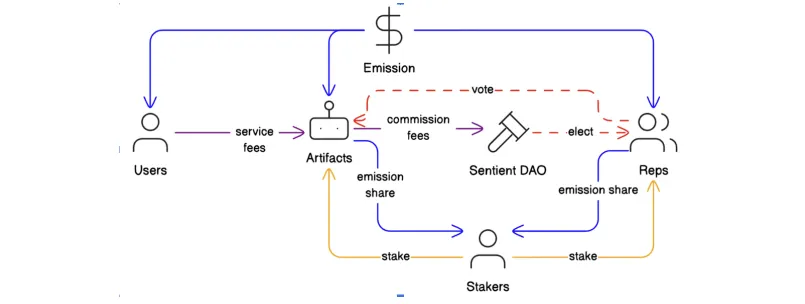
Token Emission Mechanism, source: Sentient Whitepaper v1
The emission system works like a venture investment in miniature. Community members and representatives stake tokens on artifacts they believe in, and this stake weight influences how many new tokens flow to each artifact. Models that deliver value attract more stakes over time, and models that fail to gain traction see their emissions decrease.
Three-Tier Scoring: How Contributors Get Paid Fairly
Fair compensation is essential for any sustainable open-source ecosystem. Sentient uses a three-tier scoring system to evaluate contributions and allocate rewards:
| Tier | Method | What It Measures |
| Tier 1 | Quantitative Traction Score | Lines of code, pull requests merged, model accuracy on benchmarks |
| Tier 2 | Qualitative AI Evaluation | Code quality, maintainability, task complexity |
| Tier 3 | Human Expert Review | Edge cases, fairness adjustments, suspicious pattern detection |
This layered approach catches contributions that would slip through a purely automated system. It also prevents gaming because human reviewers can identify suspicious patterns. The combination of quantitative metrics, AI assessment, and human judgment creates a more robust and fair reward mechanism.
How Sentient Protects AI Models from Theft and Misuse
Sentient employs advanced cryptographic and hardware tools to ensure models are used as licensed and data remains private. These security features address real concerns that have slowed enterprise adoption of open-source AI.
OML 1.0 Fingerprinting: Digital Watermarks for AI Models
One of Sentient's most innovative technical features is model fingerprinting, which they call OML 1.0. This system prevents unauthorized copying of AI models through a clever cryptographic technique.
During training, developers embed secret "trigger-response" pairs into the model's parameters. These pairs are invisible during normal use, but they serve as a kind of digital watermark. If a model owner suspects that someone is running an unlicensed copy of their model, they can send a secret "challenge" query. If the model responds with the expected secret trigger, this proves unauthorized use.
The evidence from fingerprinting can trigger real consequences:
- A host running an unlicensed model might have their stake slashed
- Revenue might be redirected to the rightful owner
- Legal action becomes easier with cryptographic proof
This creates strong incentives for hosts to respect licensing terms.
Sentient Enclaves (SEF): Hardware-Level Data Protection
The Sentient Enclaves Framework (SEF) provides an additional layer of security through Trusted Execution Environments (TEEs). These are special hardware features that create isolated memory regions called enclaves. Even the host operating system cannot read data inside an enclave.
Why Enclaves Matter for Enterprise AI
This matters for several use cases. Enterprises often need AI services but cannot share sensitive data with third parties. SEF allows them to use Sentient's AI capabilities while keeping their data confidential. Healthcare applications can process patient information without exposing it. Financial institutions can run analysis on proprietary data without fear of leaks.
Remote Attestation and Trustless Verification
Remote attestation adds another dimension to this security. The enclave can produce a cryptographic document proving that it ran exactly the code that was audited. Users can verify that no tampering occurred, and this creates a foundation for trustless benchmark scoring where everyone can confirm that results were generated fairly.
The home for open-source AI reasoning, image source: Sentient
$SENT Tokenomics: Utility, Staking, and Governance Explained
The $SENT token serves as the primary currency within the Sentient ecosystem. It connects developers, users, and stakers through aligned economic incentives.
What Can You Do with $SENT Tokens?
Token utility breaks down into three main categories.
Payment
$SENT is the currency for accessing AI artifacts, and users pay in tokens to use the various services registered on the GRID
Staking
Token holders can stake $SENT on artifacts they believe will succeed, and artifacts with higher stake weights receive larger shares of new token emissions
Governance
$SENT provides voting rights on emission rates, policy upgrades, and the election of Representatives who help guide the network
How the Emission Gauge Mechanism Distributes New Tokens
New $SENT tokens enter circulation through a gauge mechanism that weighs three signals:
| Signal | Full Name | What It Represents |
| V | Votes | Normalized Representative votes indicating community sentiment |
| SWS | Stake Weight Share | Total tokens staked on each artifact reflecting market confidence |
| RS | Revenue Share | Actual usage and income showing real value delivery |
This triple-weighted system balances different types of information. Votes capture subjective judgments from informed community members. Stake weights reveal where people are willing to put their money. Revenue share grounds everything in actual market performance. No single metric can be gamed without affecting the others.
Sentient DAO: How Governance Decisions Get Made
Sentient operates as a Decentralized Autonomous Organization (DAO). Token holders have direct voting rights on major decisions, but the system also includes a representative layer for day-to-day operations.
Representatives, called Reps, are elected community members or validators who take on governance responsibilities. They assign emission weights to artifacts based on their assessment of value and potential. Token holders who do not want to actively participate in governance can delegate their voting power to Representatives whose judgment they trust.
This hybrid model addresses a common problem in DAO governance. Pure direct democracy can lead to low participation and uninformed voting. Pure representative systems can become disconnected from the community. Sentient's approach combines both mechanisms so that important decisions get proper attention while routine operations run smoothly.
What Sentient Could Mean for the Future of Open-Source AGI
Sentient represents a serious attempt to build infrastructure for community-owned artificial intelligence. The project combines proven blockchain mechanics with cutting-edge AI research in ways that address real problems in the current ecosystem. Closed models dominate today, but Sentient offers a path toward more open and equitable AI development.
The $85 million in funding, the experienced founding team, and the early traction with products like Sentient Chat and Dobby all suggest this is more than just a concept. The technical innovations around fingerprinting, enclaves, and multi-agent coordination demonstrate genuine engineering progress. Whether Sentient can compete with well-funded centralized competitors remains to be seen, but the project has laid a thoughtful foundation for decentralized AGI that other developers and investors will likely watch closely.