

What Is Solana Seeker and Why Does It Matter for Web3 Mobile?
Apple and Google control nearly 100% of the mobile app ecosystem today. They charge developers up to 30% commission on revenue, and they decide which apps get approved or removed. Solana Mobile launched the Seeker device to challenge this duopoly with an open mobile platform built specifically for Web3 users.
Solana Seeker is a purpose-built smartphone developed by Solana Mobile, a subsidiary of Solana Labs. The device integrates hardware-level security with a native token called SKR to align incentives between users, developers, and hardware partners. Unlike traditional smartphones, Seeker offers a zero-commission dApp Store where developers keep 100% of their earnings. The platform reached a major milestone on January 21, 2026, when the SKR token officially launched after Season 1 generated over $2.6 billion in transaction volume.
The Seeker is the successor to the original Solana Saga phone, which achieved a 93% user engagement rate. Solana Mobile designed the Seeker for broader accessibility and a more robust decentralized infrastructure. Over 150,000 devices have shipped to more than 50 countries as of August 2025, and the ecosystem continues to grow with each new season.
Check SKR Price on LBank
SKR() Prix
Le prix actuel de
Who Built Solana Seeker? The Team Behind the $SKR Ecosystem
The Seeker ecosystem is led by veterans from the mobile and distributed systems industries. The team focuses on bridging high-performance blockchain technology with consumer mobile hardware.
Anatoly Yakovenko: From Qualcomm to Solana
Anatoly Yakovenko co-founded Solana and serves as CEO of Solana Labs. He spent 13 years at Qualcomm as a senior staff engineer manager working on operating systems. During his time at Qualcomm, he led kernel development for BREW, which powered over 100 million flip phones. He also holds patents in high-performance OS protocols. This background in mobile operating systems directly shaped the vision for Solana Mobile and the Seeker device.
Emmett Hollyer: Leading Solana Mobile Operations
Emmett Hollyer serves as General Manager of Solana Mobile and oversees business strategy and operations. Before joining Solana, he worked as a Conversational AI Consultant at Google and Principal Product Strategist at Kin + Carta. Hollyer unveiled the Seeker device at Breakpoint 2024 and has been the public face of the project's go-to-market strategy.
The broader team comprises Solana Labs engineers who specialize in distributed systems, cryptography, and mobile-first crypto experiences. This combination of mobile industry experience and blockchain expertise positions the team to execute on the ambitious goal of decentralizing mobile governance.
SKR Tokenomics: How 10 Billion Tokens Are Distributed
The SKR token is the native SPL asset of the Solana Mobile ecosystem. It launched on January 21, 2026, and functions as a tool for governance, staking, and incentive alignment across the platform.
SKR Supply and Allocation Breakdown
The total supply of SKR is capped at 10 billion tokens. The distribution prioritizes community rewards while maintaining reserves for development and partnerships.
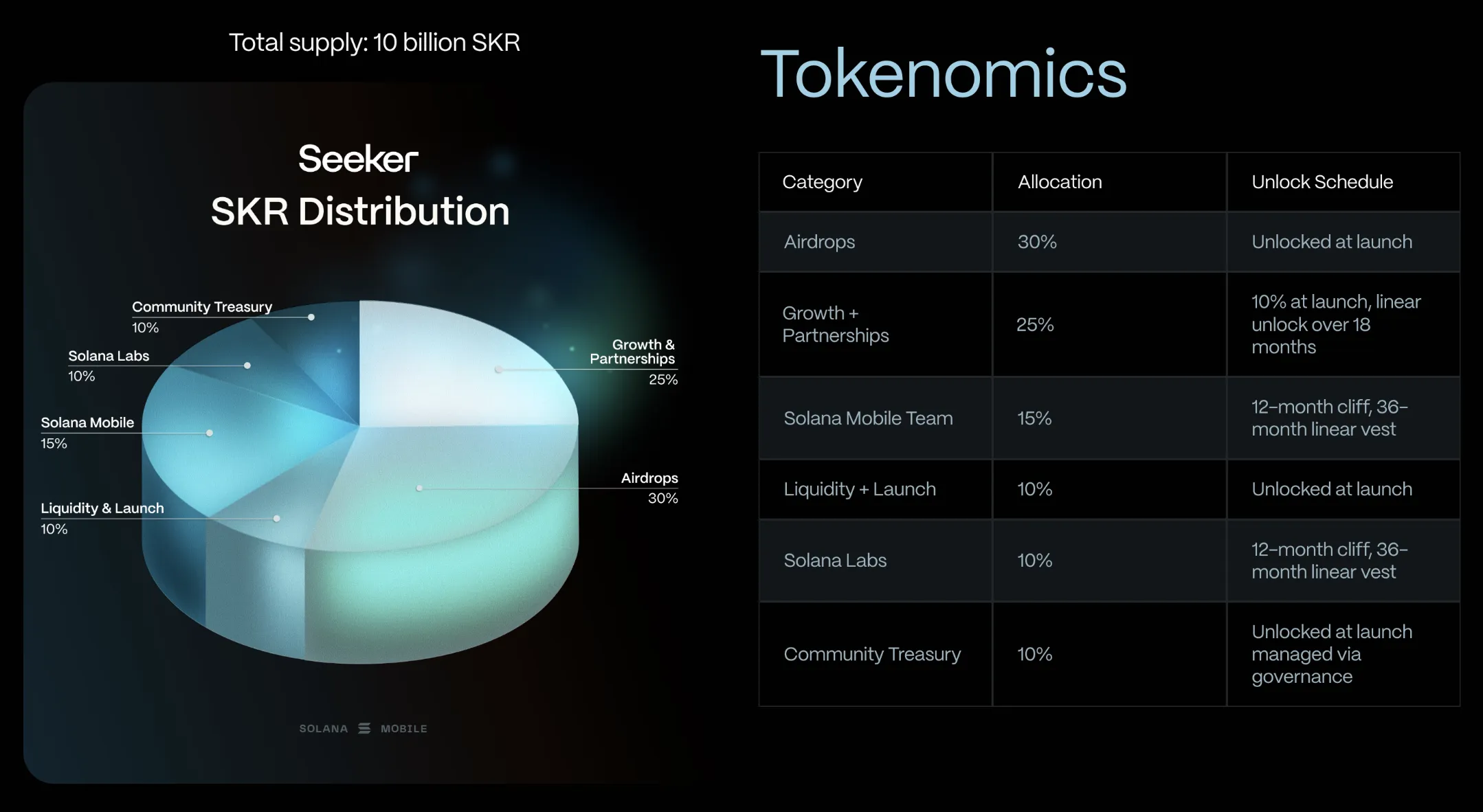
Tokenomics of SKR, image source: Solana Mobile
The allocation shows a strong emphasis on community distribution. The combined 30% airdrop allocation and 10% community treasury mean that 40% of all tokens are directed toward users and community-driven initiatives.
Season 1 Airdrop: Nearly 2 Billion SKR Distributed
The Season 1 airdrop allocated nearly 2 billion SKR (approximately 20% of total supply) to the community. Over 100,000 Seeker users and 188 developers qualified for rewards based on their engagement with the platform.
The claim window opened on January 21, 2026, and runs for 90 days until April 20, 2026. Any unclaimed tokens after this deadline will return to the airdrop pool for future distribution. Users need approximately 0.015 SOL in their wallets to cover the transaction fees required for claiming.
How to Earn SKR: Airdrops, Staking, and Developer Rewards
Users can earn SKR through several mechanisms depending on whether they are device owners, token holders, or application developers. The Solana Mobile team has outlined a clear path for participation in the ecosystem.
Claiming Your Season 1 Airdrop
If you participated in Seeker Season 1, you must manually claim your allocation through the device:
- Open your Seeker device and navigate to the Seed Vault Wallet
- Tap the Activity Tracking tab
- Ensure you have approximately 0.015 SOL to cover the network transaction fee
- Tap Claim to receive your SKR
- Complete the claim before April 20, 2026, or tokens return to the airdrop pool
Staking SKR with Guardians
Step 1: Get a Seeker Device
The first step to earning SKR is owning a Seeker device. Device ownership unlocks access to exclusive dApps, SKR rewards, and full control over your mobile experience. The Seeker is priced at $500 during the Early Adopter Window, and over 150,000 devices have already shipped to more than 50 countries.
Step 2: Use Your Seeker and Activate Your Genesis Token
If you have been using your Seeker and engaging with dApps, you are already positioned for upcoming rewards. Active participation with applications on the platform determines your eligibility for seasonal airdrops and other incentives.
If you have not activated your Seeker Genesis Token yet, you still have time to do so. The activation process happens through your Seed Vault Wallet on the device. The Genesis Token serves as proof of early adoption and unlocks additional earning opportunities within the ecosystem.
Step 3: Stake SKR with Guardians
Once you own SKR tokens, you can generate passive rewards by delegating to Guardians who secure the platform. Staking went live in January 2026 and allows token holders to earn rewards while participating in ecosystem governance.
| Staking Parameter | Value |
| Initial APY | 10% (Year 1 inflation) |
| Inflation Events | Every 48 hours |
| Commission Rate | 0% at launch |
| Unstaking Cooldown | 48 hours (2-day epochs) |
Rewards are distributed during inflation events and compound automatically. The 48-hour unstaking period means users cannot immediately withdraw their tokens, which helps stabilize the network security provided by staked tokens. Beyond earning rewards, stakers also shape the ecosystem through governance participation.
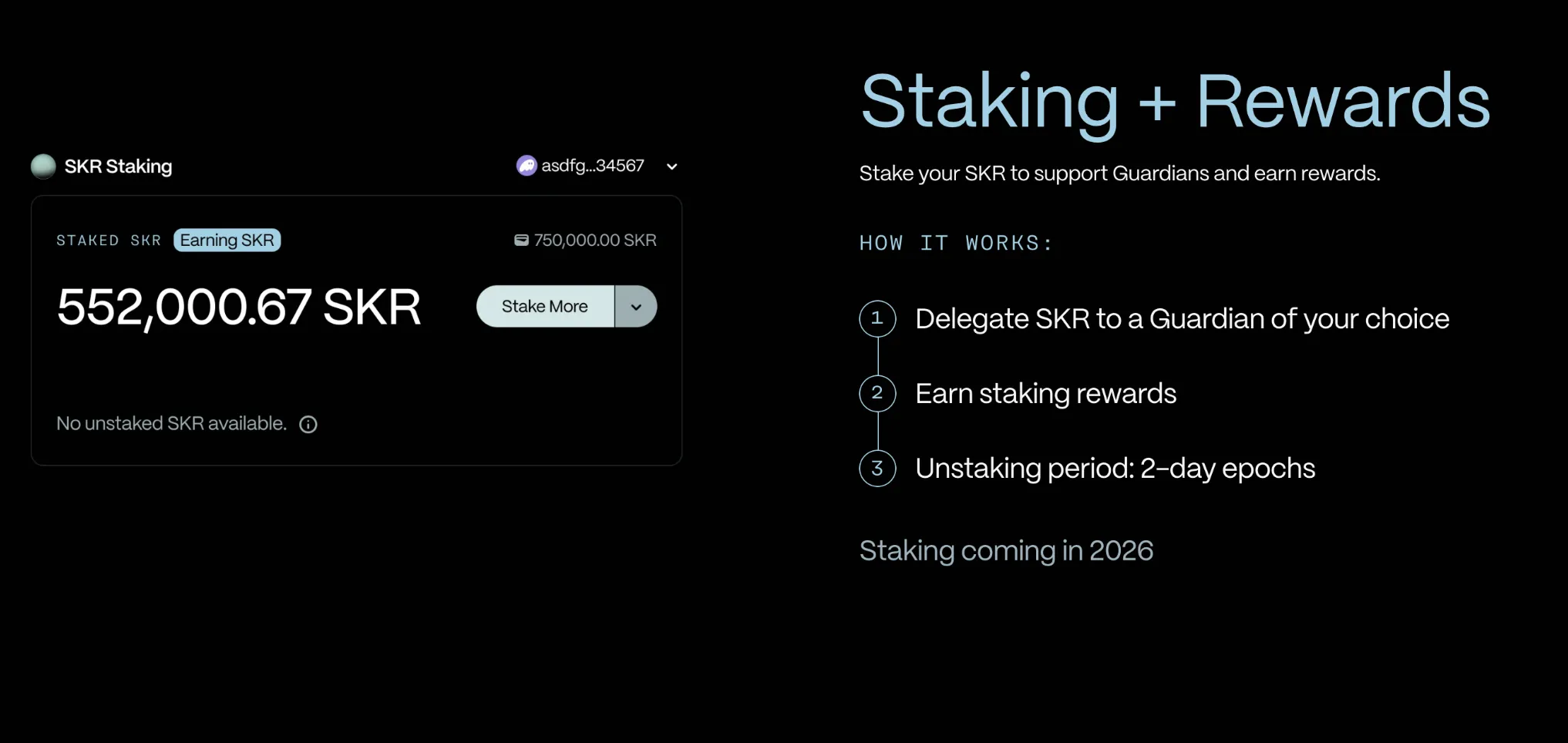
SKR staking, image source: Solana Mobile
Developer Incentives and Grants
Developers can earn SKR by building and launching applications to the Solana dApp Store. Unlike traditional app stores controlled by Apple and Google, the Seeker platform uses community standards for app review instead of arbitrary gatekeepers.
The zero-fee model means developers keep 100% of what they earn. There are no commissions taken from app revenue or in-app purchases.
| Earning Method | Description | Requirement |
| Airdrops | Seasonal distributions based on activity | Ownership and use of Seeker device |
| Staking | Delegating SKR to platform Guardians | Holding SKR tokens; 48-hour cooldown |
| App Usage | Engaging with DeFi, DePIN, and gaming dApps | Activating the Genesis Token NFT |
| Building | Shipping apps to the zero-fee dApp Store | Qualifying for the Developer Grant program |
In Season 1, 141 million SKR was allocated to 188 developers who shipped quality apps to the Solana dApp Store. Qualifying teams received 750,000 SKR each. Combined with the zero-commission policy, developers have strong financial incentives to build on Seeker instead of traditional app stores.
Seeker Seasons Explained: How Users Earn Rewards
The Seeker ecosystem uses a "Seasons" model to track engagement, distribute rewards, and onboard new partners. Each season creates focused periods of activity where users earn tokens based on their on-chain behavior.
Season 1 Results: $2.6 Billion in Volume
Season 1 demonstrated significant market traction and validated the demand for a Web3-native mobile platform.
| Metric | Result |
| dApps Launched | 265+ |
| Transactions Processed | 9 million |
| Total Volume | $2.6 billion |
| Active Seekers | 100,000+ |
| Developers Rewarded | 188 |
The airdrop distribution followed a 5-tier engagement system. Users received tokens based on their activity level during the season.
- Sovereign: 750,000 SKR
- Luminary: 125,000 SKR
- Vanguard: 40,000 SKR
- Prospector: 10,000 SKR
- Scout: 5,000 SKR
Season 2: New Partners and Featured Apps
Season 2 launched immediately after the SKR token debut and focuses on high-utility applications across DeFi, gaming, and DePIN. Notable featured partners include:
- Orb (by Helius): A mobile-first UI for real-time portfolio tracking and DeFi interaction
- Dev.fun: A platform for onchain capital raising and project discovery
- Baxus: A specialized app for crowdsourced "bottle hunting" and location tagging
- Loopscale: A strategic partner for the new season
Season 2 offers new opportunities for distributions to users who engage with these featured applications. The seasonal model creates ongoing incentives for users to explore new dApps and remain active on the platform.
Solana Mobile platform, image source: Solana Mobile
How TEEPIN and Guardians Secure Seeker
A core innovation of the 2026 roadmap is the introduction of TEEPIN (Trusted Execution Environment Platform Infrastructure Network) and the Guardians program. These systems work together to ensure that no single company controls the Seeker ecosystem.
What Do Guardians Actually Do?
Guardians are independent operators who secure the platform through several critical functions:
- Device Verification: They verify device identity and software integrity to prevent fraudulent hardware from accessing the network
- App Curation: They review and approve dApp Store submissions based on community standards
- Reward Distribution: They distribute staking rewards to users who delegate tokens to them
This decentralized approach means that app approval is not controlled by a single company like Apple or Google. Instead, a network of independent operators makes these decisions based on transparent community guidelines.
The Initial Guardian Cohort
The following entities have been selected as the inaugural Guardians for the Seeker network:
- Anza — Infrastructure provider
- DoubleZero — Network operator
- Triton — Solana infrastructure specialist
- Helius — Developer tools and RPC provider
- Jito — MEV infrastructure provider
- Solana Mobile — Initial Guardian during bootstrap phase
Solana Mobile serves as the initial Guardian during the network bootstrap phase, but the plan is to fully decentralize control as the Guardian network matures throughout 2026.
Solana Seeker Hardware: Specs and Security Features
The Seeker device combines competitive hardware specifications with purpose-built security features for Web3 users.
Device Specifications
The Seeker hardware is positioned as a mid-range smartphone with premium features designed for blockchain interactions:
- Display: 6.36" AMOLED with 120Hz refresh rate
- Processor: MediaTek Dimensity 7300
- Memory: 8GB RAM
- Price: $500 during the Early Adopter Window
The pricing strategy targets users who want a dedicated Web3 device without paying premium flagship prices. At $500, the Seeker undercuts most flagship smartphones from Apple and Samsung while offering specialized crypto functionality.
Seed Vault Wallet: Hardware-Level Security
The Seed Vault Wallet was created in partnership with Solflare and integrates directly with the Seeker's hardware security module. Unlike software-based wallets, the Seed Vault stores private keys in isolated hardware that cannot be accessed by other applications or the operating system.
Key features include:
- Double-Tap Transactions: Users confirm transactions with a physical double-tap gesture that cannot be replicated by malware
- Streamlined Account Management: The wallet interface is designed for quick access to balances and transaction history
- Hardware Isolation: Private keys never leave the secure enclave, even during transaction signing
This hardware-based approach provides stronger security than software wallets that store keys in regular device memory.
Solana Seeker vs. Traditional Mobile: Key Differences

The zero-commission model represents the most significant difference for developers. On traditional platforms, a developer earning $1 million in revenue would pay $300,000 to Apple or Google. On Seeker, that same developer keeps the full $1 million. Developers behind apps like Scrolly and Pyra have cited this as a major growth lever for their projects.
The governance model also represents a fundamental shift. Traditional app stores operate under centralized corporate control where a single company can remove apps or change policies without user input. The Seeker ecosystem distributes this power across the Guardian network and SKR token holders, creating accountability through decentralized decision-making.
What Solana Seeker Means for the Future of Mobile
The Seeker ecosystem represents a genuine attempt to break the mobile duopoly that has controlled smartphone users and developers for over a decade. With 150,000 devices shipped, $2.6 billion in Season 1 volume, and a carefully designed token economy, the project has moved beyond concept to real market traction.
The transition to decentralized app curation via Guardians remains a critical milestone to watch in 2026. If the Guardian network can effectively manage app reviews without the bottlenecks and arbitrary decisions common on traditional platforms, it could provide a template for other decentralized mobile projects.
The 90-day claim window for Season 1 airdrops ends on April 20, 2026, and this deadline creates urgency for eligible users. Season 2 is already underway with new partner applications, and the staking system offers ongoing rewards for token holders who support network security. Whether Solana Seeker can achieve mainstream adoption remains to be seen, but the infrastructure and community incentives are now in place for the next phase of growth.
Official SKR Contract Addresses and Resources
To maintain security and ensure accurate participation, users should verify they are interacting with official Solana Mobile contracts and resources.
- SKR Token Contract Address: SKRbvo6Gf7GondiT3BbTfuRDPqLWei4j2Qy2NPGZhW3
- SKR Staking Program ID: SKRskrmtL83pcL4YqLWt6iPefDqwXQWHSw9S9vz94BZ
- Official Staking Portal: stake.solanamobile.com
Always verify contract addresses before interacting with any token or staking program. Scammers often create fake tokens with similar names to steal funds from users who do not check official sources. Learn more about Solana (SOL).