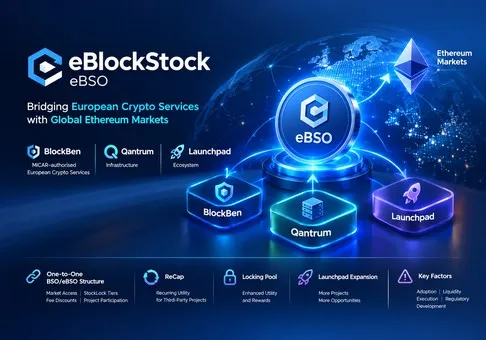
eBlockStock Project Overview
EBSO Token: https://www.lbank.com/trade/ebso_usdt
Executive Overview
BlockBen combines regulated crypto-asset services, digital asset infrastructure and public-blockchain connectivity within a unified platform for project issuance and ecosystem participation. Its operating model is centered on a MiCAR-authorised Crypto-Asset Service Provider in Latvia and is designed to support third-party projects throughout the full asset lifecycle, from commercial structuring and tokenomics to technical deployment, market access and ongoing administration.
Unlike a launchpad focused only on fundraising or token distribution, BlockBen brings project preparation, issuance infrastructure and post-launch services into one continuous framework. This gives the platform three complementary roles: an infrastructure provider, a service provider and an ecosystem coordinator. Qantrum supplies the platform-oriented ledger environment, BlockBen Wallet provides the user interface, and the Launchpad connects new projects with BlockBen's operating and participation systems.
eBSO, or eBlockStock, is the ERC-20 representation of BlockBen's BlockStock ecosystem token on Ethereum. Inside the BlockBen environment, the same asset operates as BSO on Qantrum and through BlockBen Wallet. BSO provides access to StockLock, participation tiers, fee discounts, project access, partner benefits and Locking Pool eligibility. eBSO extends the asset beyond the platform by supporting external wallets, transfers, interoperability and exchange trading.
The relationship between BSO and eBSO is based on one-to-one conversion. This structure separates platform utility from public-market accessibility while preserving one underlying asset relationship. A holder may therefore obtain eBSO in an external market, transfer it to BlockBen Wallet, convert it to BSO and use the platform functions associated with the relevant participation tier.
1.1 Project Development and Business Positioning
BlockBen's development history dates back to 2018. The project initially concentrated on blockchain infrastructure and digital asset products, then expanded into an integrated environment that includes Qantrum, BlockBen Wallet, asset issuance services and the BlockStock ecosystem token. As the European Markets in Crypto-Assets Regulation entered implementation, BlockBen further developed its operating structure around regulated services and a third-party project Launchpad.
The resulting model covers multiple stages before and after issuance. During the preparation stage, BlockBen can support commercial-model definition, asset utility, supply design, participation mechanics and project documentation. During issuance, the platform provides technical deployment, asset creation, wallet integration and market connectivity. After launch, the relationship can continue through lifecycle administration, ecosystem programs, user services and asset operations.
This vertically connected approach turns token issuance from a single event into a continuing project-service relationship. For third-party projects seeking access to European users and infrastructure, the model brings business design, technical implementation and ongoing platform participation into one operating environment.
1.2 MiCAR-Authorised CASP Framework
BlockBen SIA is registered in Latvia under company number 50203650041, with Legal Entity Identifier 254900BBV7FA7LUG5913. Its Crypto-Asset Service Provider licence, numbered 27-55/2025/9, became effective on 3 December 2025.
The authorised service scope aligns closely with the platform model. Custody and administration capabilities support BlockBen Wallet and customer asset services. Exchange and transfer services connect assets across supported environments. Crypto-asset placement capabilities correspond to the project issuance and Launchpad functions. Together, these permissions establish one European operating foundation for wallet services, asset movement, exchange, placement and administration.
Through the freedom-to-provide-services mechanism, BlockBen SIA can extend relevant services across multiple European Economic Area markets. This gives third-party projects a coordinated European entry point under a consistent service structure, supporting broader planning for user access, wallet integration and ecosystem participation.
1.3 Legal Entities and Operating Roles
The BlockBen ecosystem includes several entities with defined roles across its development and current operations.
|
Entity
|
Jurisdiction
|
Primary Role
|
|
BlockBen SIA
|
Latvia
|
Current BlockStock issuer and authorised CASP
|
|
BlockStock UAB
|
Lithuania
|
eBSO/BSO offeror and ReCap processing entity
|
|
BlockBen Financial Services OÜ
|
Estonia
|
Historical entity associated with early BlockStock development and issuance
|
This structure reflects the project's development from its earlier operating phase into a model centered on the Latvian CASP entity. The separate roles support issuance, platform services and asset-lifecycle functions while maintaining continuity across the BlockStock ecosystem.
1.4 Team
BlockBen's team spans financial services, blockchain engineering, product development, operations and corporate governance. The project presents a management structure capable of connecting technical infrastructure with regulated crypto-asset services and project operations.
|
Team Member
|
Role
|
|
Béla Farkas
|
Chairman of the Management Body
|
|
Dr István Nagy
|
Member of the Management Body; AML/CFTresponsibility
|
|
Viktor Mark Bodnar
|
Chairman of the Management Body
|
|
Attila Krocsek
|
Member of the Management Body
|
|
Luize Berzina
|
Member of the Management Body; AML/CFTresponsibility
|
2. BSO and eBSO Dual-Environment Architecture
2.1 Functional Division
BlockStock operates through two technical representations. BSO is the platform-oriented form used on Qantrum and within BlockBen Wallet. It connects holders with StockLock, participation tiers, fee discounts, project programs and partner benefits. eBSO is the Ethereum ERC-20 representation used for public transfers, exchange trading and Web3 interoperability.
|
Representation
|
Operating Environment
|
Principal Function
|
|
BSO
|
Qantrum and BlockBen Wallet
|
StockLock, tiers, fee discounts, project participation and ecosystem utility
|
|
eBSO
|
Ethereum
|
External wallets, transfers, exchange trading and Web3 interoperability
|
The distinction is functional rather than economic. BSO and eBSO represent the same BlockStock asset in environments designed for different purposes. Qantrum provides a managed platform setting for utility and participation, while Ethereum provides public accessibility and compatibility with external services.
2.2 One-to-One Conversion
BSO and eBSO can be converted on a one-to-one basis. During conversion, the representation in one environment is removed as the corresponding representation becomes available in the other environment. This design maintains a unified asset relationship while allowing users to select the technical environment appropriate to their intended activity.
A holder seeking external transferability or exchange access can use eBSO on Ethereum. A holder seeking platform utility can move the asset into BlockBen Wallet and convert it to BSO. The same mechanism allows BSO to return to eBSO when external accessibility is preferred.
This two-way structure gives BlockStock both a public-market interface and an ecosystem-utility interface. It also allows BlockBen to develop platform functions independently from Ethereum transaction logic while retaining a clear connection between the two environments.
3. Qantrum Digital Asset Infrastructure
Qantrum is BlockBen's hybrid distributed-ledger infrastructure for managed and regulated digital asset environments. It combines encrypted data management, distributed records, identity functions and institution-oriented control mechanisms to support asset issuance, administration, transfer and verification.
The system uses a clustered architecture in which participating institutions can operate distinct ledger clusters and exchange verified information. Records are maintained in an immutable ledger layer, while a World State Machine provides efficient access to current state data. This structure supports auditability without requiring every business process to operate in the same way as a public permissionless blockchain.
Qantrum's execution environment uses a TypeScript-based runtime and microservice-oriented transaction handling. Two-phase commit and an extended RAFT-style consensus mechanism support coordinated processing. Identity proofs, zero-knowledge techniques, distributed key generation and multi-party signing provide additional building blocks for institutional and regulated use cases.
Private keys can be generated on user devices, and segmented key-management methods connect user authorisation with system-level controls. The disclosed cryptographic components include BLS12-381, secp256k1, ECIES, AES, HMAC, SHA, bcrypt and scrypt. Research into post-quantum approaches, including ML-KEM and ML-DSA, forms part of the platform's longer-term technical direction.
Qantrum Explorer provides a public interface for examining network records, blocks and related proof information. Ethereum and Qantrum therefore offer two different forms of transparency: Ethereum exposes eBSO activity through a public blockchain, while Qantrum Explorer provides visibility into the platform ledger environment.
4. StockLock and the Tier Participation System
4.1 StockLock
StockLock is a BlockBen Wallet function that turns BSO holdings into continuing ecosystem participation. A user may lock a specified amount of BSO until the end of an applicable period and enter the tier corresponding to that amount. The resulting tier connects the user with defined platform benefits and project opportunities.
The participation path begins with acquiring eBSO and transferring it to BlockBen Wallet. The asset is then converted to BSO, entered into StockLock and associated with the relevant tier. Once the tier is active, the user can access the ecosystem benefits attached to that participation level.
StockLock gives BlockStock a continuing platform function beyond external transferability. The mechanism also provides BlockBen and incoming Launchpad projects with an organised participation framework in which users are grouped according to the depth of their ecosystem commitment.
4.2 Tier Structure
The tier framework uses locked BSO balances to define participation levels. Higher tiers can provide greater allocation weight, larger fee discounts and broader ecosystem access. The BSO Power Multiplier is used when calculating participation weight in applicable distribution programs; it does not change the number of BSO units held by the user.
|
Tier
|
Locked BSO
|
BSO Power Multiplier
|
Platform Fee Discount
|
Main Benefits
|
|
I
|
Basic holding
|
-
|
-
|
Entry to BlockBen ecosystem features and activities
|
|
II
|
More than 5,000
|
1.00x
|
5%
|
Foundational tier benefits
|
|
III
|
More than 20,000
|
1.15x
|
10%
|
Early Access
|
|
IV
|
More than 50,000
|
1.30x
|
15%
|
Bonus Allocation
|
|
V
|
More than 100,000
|
1.40x
|
20%
|
Pre-Presale access and priority support
|
|
Legend
|
More than 1,000,000
|
1.50x
|
30%
|
Invitation-only activities and management engagement opportunities
|
4.3 Benefit Framework
StockLock is designed to connect users with more than a single discount mechanism. Depending on the relevant tier and program, benefits can include platform fee reductions, Early Access, Pre-Presale opportunities, priority support, Locking Pool eligibility, partner products and services, exclusive campaigns, and invitation-based online or in-person events.
The framework can expand alongside the Launchpad. Each new project can introduce additional participation scenarios, allowing a common tier system to support a broader set of benefits without requiring users to navigate a separate participation structure for every project.
5. Locking Pool and ReCap
5.1 Locking Pool
The Locking Pool links ecosystem activity with StockLock participation. Digital assets originating from BlockBen programs or partner projects may be allocated through a Locking Pool under the conditions of the relevant activity. Eligible StockLock participants can then receive allocations according to those conditions.
Allocation weight may take into account the amount of BSO locked, the user's StockLock tier and the applicable BSO Power Multiplier. Individual programs can add their own participation requirements, allowing the same framework to support different project distributions and ecosystem campaigns.
For Launchpad projects, the Locking Pool provides access to an established and structured participant base. For users, it creates a direct connection between platform participation and new ecosystem activity. As the number of projects and partner programs grows, the Locking Pool can accommodate a wider range of assets and allocation scenarios.
5.2 ReCap
ReCap, short for Redemption Capability, provides an official processing path for BSO/eBSO holders. A holder may submit a request through the designated support channel, after which BlockStock UAB processes the request under the applicable methodology, operating procedures and compliance workflow.
The redemption price is published through BlockBen's official channels and is calculated independently from the secondary-market price. Effective from 15 September 2026, the published redemption price was EUR 14.18 per 1,000 eBSO, equivalent to EUR 0.01418 per token.
StockLock and ReCap serve different user objectives. StockLock is oriented toward ecosystem participation and platform benefits, while ReCap provides an official asset-processing and lifecycle function. Together, they extend BlockStock utility across holding, participation, conversion and administration.
6. Token Economics and Supply Structure
6.1 Core Token Parameters
|
Parameter
|
Value
|
|
Token Name
|
eBlockStock
|
|
Symbol
|
EBSO
|
|
Ecosystem Representation
|
BSO / BlockStock
|
|
Network Standard
|
Ethereum ERC-20
|
|
Decimals
|
4
|
|
Ethereum Contract
|
0x866f8a50A64e68ca66E97e032c5Da99538B3F942
|
|
Maximum Supply
|
750,000,000 BSO/eBSO
|
|
Ethereum Supply Snapshot
|
83,621,297.4225 eBSO
|
|
Contract Status
|
Active and not paused
|
|
Current Transfer-Fee Parameters
|
bsoFee = 0; generalFee = 0
|
The Ethereum supply snapshot reflects the state observed on 16 September 2026. Because BlockStock can move between BSO on Qantrum and eBSO on Ethereum, the number of eBSO units represented on Ethereum changes with the direction and volume of conversions.
6.2 Supply Distribution
BlockStock has a maximum supply of 750,000,000 units. The supply exists across BSO in the Qantrum environment and eBSO on Ethereum, rather than as two separate economic supplies. A conversion into eBSO increases the Ethereum representation, while a conversion back into BSO returns the corresponding amount to the BlockBen platform environment.
|
Supply Category
|
Units
|
|
Maximum BlockStock Supply
|
750,000,000
|
|
Displayed Circulating Supply
|
538,749,161
|
|
Promotional Allocation
|
12,422,000
|
|
Partner Allocation
|
10,000,000
|
|
General Reserve
|
80,000,000
|
|
BlockBen SIA Allocation
|
20,000,000
|
|
Disclosed Issuer Retention
|
1,100,000
|
The categories support market circulation, ecosystem promotion, partner activity, reserve management and issuer operations. Ethereum-based eBSO remains a dynamic portion of the overall BlockStock supply rather than an additional issuance layer.
6.3 Utility Layers
BlockStock utility can be understood through four connected layers. At the circulation layer, eBSO supports public wallets, exchanges and Ethereum interoperability. At the platform layer, BSO provides access to BlockBen ecosystem functions. At the benefit layer, StockLock and the tier system connect participation with discounts, project access and partner programs. At the ecosystem layer, the Locking Pool and new Launchpad projects expand the set of activities in which BSO can be used.
These layers make external market access and internal utility mutually reinforcing. eBSO provides an accessible entry point, while BSO gives the asset an active role inside the platform.
7. Smart Contract and Technical Transparency
The eBSO contract follows the ERC-20 standard and includes role-based management functions suited to asset conversion, platform operations and address administration. The contract uses separate TOKEN_ADMIN, TREASURY_ADMIN and AML_ADMIN roles, distributing responsibilities across parameter management, treasury and BSO/eBSO conversion functions, and address-level administration.
The implementation supports standard ERC-20 balances, transfers and allowances, together with mint and burn operations used in the conversion process. It also includes treasury-address administration, BSO Pool and fee-address management, configurable fee parameters, contract pause and resume functions, and role-controlled operational actions.
As of 16 September 2026, the contract was active and not paused. Both the bsoFee and generalFee parameters were set to zero. The disclosed contract, source code, ABI, deployment scripts, test materials and audit information provide technical visibility for developers and ecosystem participants.
The eBSO contract completed a CertiK security audit in 2021. The audit used automated analysis and manual review, and its findings were incorporated into the contract-development process. Qantrum Explorer complements Ethereum transparency by providing a verification interface for the platform ledger environment.
8. BlockBen Launchpad and Project Services
BlockBen Launchpad is designed for third-party projects seeking structured crypto-asset issuance and access to European markets. Its role extends beyond listing or distribution. The platform connects project selection, business and token design, regulatory preparation, technical deployment, wallet integration, market access and continuing asset administration.
The service process begins with project screening and preparation. Commercial structure, tokenomics, asset purpose and participation mechanics can then be translated into technical and documentary requirements. After deployment, the project can connect with Qantrum, BlockBen Wallet, market channels and the existing StockLock participant base.
The post-launch phase is equally important to the model. Lifecycle management, ecosystem programs, partner activity and user services allow each project to remain connected to the platform after issuance. This creates a repeatable framework in which every additional project can add new utility and participation opportunities to the broader BlockBen ecosystem.
9. Launchpad Ecosystem Value Cycle
eBSO/BSO serves as the connection between third-party projects, BlockBen services and platform users. A user may enter through the eBSO market, convert the asset into BSO, participate in StockLock and gain access to project-related opportunities associated with the relevant tier. New Launchpad projects can then introduce additional activities and benefits into the same participation framework.
As the platform adds projects and partners, the number of potential participation scenarios increases. StockLock provides a structured user base, the Locking Pool offers a reusable allocation mechanism, and eBSO keeps the ecosystem connected to Ethereum and external markets. The result is a cycle in which project growth can expand BSO utility, while an organised participant community can support new project launches.
10. Market Connectivity and Data Snapshot
eBSO connects to the external market through Ethereum and the LBank EBSO/USDT trading pair. This provides a public market entry point for the BlockBen ecosystem and gives users a route from exchange-based acquisition to platform participation.
The following figures reflect the LBank market snapshot observed at 16:25 UTC+8 on 16 September 2026.
|
Market Indicator
|
Snapshot Value
|
|
Latest Price
|
0.021005 USDT
|
|
24-Hour High
|
0.021342 USDT
|
|
24-Hour Low
|
0.019235 USDT
|
|
24-Hour Change
|
+8.11%
|
|
24-Hour Volume
|
45,587,834.23 eBSO
|
|
24-Hour Turnover
|
914,842.5314 USDT
|
At the snapshot price, the 750,000,000 maximum supply corresponded to approximately 15.75 million USDT. The 83,621,297.4225 eBSO represented on Ethereum corresponded to approximately 1.76 million USDT, while the displayed circulating supply of 538,749,161 units corresponded to approximately 11.32 million USDT.
External market connectivity and internal platform utility are complementary. Ethereum provides public transferability and wallet access, while BlockBen Wallet connects holders with StockLock, participation tiers and project programs. Market activity can therefore become a gateway to platform participation rather than remaining isolated from the wider ecosystem.
11. Development Roadmap
The published roadmap progresses from market connectivity and StockLock activation toward additional Launchpad projects, partnerships and international coverage.
The third quarter of 2026 focuses on foundational connectivity through eBSO's return to LBank, the launch of StockLock tiers and expansion into the Canadian market. This phase combines external market access with practical use of the tier framework, linking eBSO trading accessibility with BSO platform utility.
The fourth quarter of 2026 is planned around new platform projects, expanded trading services and additional market access. This stage is intended to demonstrate the interaction between the Launchpad and StockLock: new projects give tier benefits concrete applications, while StockLock provides incoming projects with an organised base of potential participants.
The first quarter of 2027 extends the model through additional exchange coverage, new ecosystem partnerships and entry into more markets. The second quarter of 2027 is allocated to the announcement of the next product and ecosystem phase. Taken together, the roadmap moves from access and activation toward project supply, partnership depth and international scale.
12. Ecosystem Highlights
12.1 European Operating Foundation
BlockBen SIA's CASP status and authorised service scope provide one operating entity for wallet services, exchange, transfers, placement and crypto-asset administration. For third-party projects seeking a European entry point, this foundation connects with tokenomics, technical issuance and post-launch operations to form a continuous service framework.
12.2 Interoperability Across Two Environments
eBSO connects BlockStock with Ethereum's public accessibility, while BSO activates utility in Qantrum and BlockBen Wallet. Users can acquire and transfer the asset externally, then enter the platform to use StockLock, tiers and project benefits. The asset can therefore operate in the environment best suited to each activity.
12.3 Expandable Participation Framework
StockLock organises holders by participation depth and connects tiers with the BSO Power Multiplier, fee discounts and project benefits. Because new projects can use the existing framework, each Launchpad addition can create further BSO use cases without requiring an entirely separate user structure.
12.4 Technical Visibility
The Ethereum contract, source code, tests and audit materials provide public visibility into eBSO operations. Qantrum Explorer offers a separate verification interface for the platform ledger. The two environments therefore provide complementary transparency for public circulation and managed platform activity.
13. Ecosystem Outlook
BlockBen is developing an operating system centered on European crypto-asset services, Qantrum infrastructure and a third-party project Launchpad. Within this structure, eBSO/BSO performs two connected roles: eBSO links BlockBen with Ethereum, wallets and exchange markets, while BSO links users with StockLock, tiers, the Locking Pool and new-project benefits.
As StockLock tiers enter full operation, participation can move from simple holding toward differentiated platform use. Fee discounts, Early Access, Pre-Presale opportunities, partner benefits and dedicated activities can continue to develop around a common tier framework. For third-party projects, this provides an established structure for user organisation and engagement; for BlockBen, it allows each new project to become an additional source of ecosystem utility.
Growth in the Launchpad can also broaden the role of the Locking Pool. New projects, partner campaigns and platform programs can introduce additional assets and participation scenarios, while the BSO Power Multiplier provides a consistent way to express different levels of engagement. ReCap complements this participation structure with an official processing path across the asset lifecycle.
Over the longer term, BlockBen's model does not depend on a single market or application. The CASP framework establishes the operating boundary, Qantrum provides the platform ledger, Ethereum provides public connectivity, BlockBen Wallet supplies the user interface, and the Launchpad expands the project network. eBSO/BSO is the shared asset that connects these components and turns infrastructure into a user-facing ecosystem.
Web3 Innovation. European Standards.
eBSO connects BlockBen with external markets. BSO activates platform utility. Together, they link third-party projects, digital asset infrastructure and ecosystem participation.