

What deBridge Is and Why the Problem It Solves Matters
Every time a new blockchain gains meaningful adoption, it creates a new silo. Users on Ethereum cannot access Solana's DeFi yields without converting assets and moving between platforms. Capital locked on Arbitrum cannot participate in Tron's USDT markets without going through multiple steps, each introducing fees, delays, and risk. The multi-chain world that crypto promised has arrived, but it arrived in fragments.
DeBridge is a decentralized cross-chain interoperability protocol built to connect those fragments. It enables the seamless transfer of assets and data across 26 or more blockchains, including Ethereum, Solana, BNB Chain, Tron, Base, and Arbitrum, without locking liquidity in pools or creating wrapped tokens that can be exploited. The protocol has processed over $2.35 billion in transfer volume from more than 385,000 unique users since launching on mainnet in 2022, and generates approximately $100,000 in daily protocol fees.
The problem with most cross-chain bridges is structural. Traditional bridges work by locking assets in a smart contract on the source chain, then minting a wrapped version on the destination chain. That locked pool is a target. Hackers have found and exploited it repeatedly. deBridge eliminates the pool entirely.
How deBridge Actually Works: The Intent-Based Architecture
The core of deBridge is the deBridge Liquidity Network, commonly referred to as DLN. Instead of locking assets in a pool, the DLN operates as an intent-based execution system. When a user wants to move value across chains, they broadcast their intent to the network. A decentralized network of professional solvers then competes to fulfill that order directly, using their own liquidity, and get reimbursed on the source chain.
The practical result is that there is no central pool to hack, no wrapped token to de-peg, and no slippage from pool mechanics. Solvers compete on price and speed, so users often get guaranteed rates near or at spot. Settlement is near-instant. The protocol describes its model as "zero TVL" for exactly this reason: total value locked on the protocol is not the point, because deBridge does not hold value in the traditional bridge sense.
Security is handled by a decentralized validator network that uses threshold cryptography to sign and verify every cross-chain message. Validators must stake DBR as collateral and face slashing if they behave maliciously, whether by forging or censoring transactions. The network has maintained zero downtime incidents since its 2022 mainnet launch, which is a meaningful operational track record in a category defined by exploits.
Beyond simple bridging, deBridge supports cross-chain smart contract calls, meaning an application on one blockchain can trigger operations on another in a single transaction. In December 2025, the team launched deBridge Bundles, which allows users to group multiple cross-chain operations into a single atomic transaction. You can swap an asset, deploy it as collateral on another chain, and borrow against it, all in one click. That level of composability has not previously been possible across chains.
The Founder: Alex Smirnov
Alex Smirnov is the co-founder and CEO of deBridge. His background sits at the intersection of rigorous academic mathematics and practical software engineering, which is exactly the profile needed to build serious cryptographic infrastructure.
Smirnov holds a Master's degree in Mechanics and Mathematics from Lomonosov Moscow State University, one of Russia's most prestigious academic institutions. He pursued a PhD in Mathematics and Physics at the same institution from 2014 to 2018, and has authored eight scientific papers presented at international conferences. His research background is in applied mathematics, including inertial navigation and pedestrian dead reckoning systems, areas that require the same precision and systems thinking that secure cross-chain protocols demand.
His path into crypto began in 2016, when he first encountered blockchain technology. After researching the space, he made the decision to leave his PhD program to pursue Web3 full time. That is not a small commitment for someone with his academic trajectory, and it reflects the depth of conviction he brought to the problem.
Before deBridge, Smirnov co-founded Phenom, a blockchain research and development company focused on secure crypto custody solutions for financial institutions. That work gave him direct experience with the institutional constraints around digital asset security, which informed deBridge's emphasis on validator accountability, slashing conditions, and zero-TVL architecture.
The specific moment that motivated deBridge came from practical frustration. Smirnov and his co-founders were running cross-chain arbitrage operations and kept running into the same problem: moving assets between chains was slow, expensive, and unreliable. Bridges would freeze funds. Exchanges had lengthy withdrawal queues. The infrastructure simply was not built for the use case. Rather than working around the problem, they decided to build the solution from scratch. The winning entry at the Chainlink Global Hackathon in 2021, where the deBridge concept defeated more than 140 competing projects for the Grand Prize, was the proof of concept that launched the project into production. Smirnov is currently based in Dubai.
The Funding History and Who Backed It
deBridge's funding story is notable for its capital efficiency relative to the volume the protocol has processed.
The seed round of $5.5 million closed in September 2021, led by ParaFi Capital with participation from Animoca Brands, IOSG Ventures, The LAO, Double Peak, Bitscale Capital, and others. An IDO on Jupiter's LFG launchpad raised an additional $5 million at the time of the DBR token launch in October 2024. Total disclosed funding stands at approximately $10.5 million.
Processing over $2.35 billion in transfer volume on roughly $10.5 million in total raised capital is an unusual ratio in the cross-chain infrastructure space, where competitors have raised hundreds of millions. It suggests the protocol has found genuine product-market fit rather than buying adoption through liquidity incentives.
deBridge: Key Milestones From Launch up to today
deBridge won the Chainlink Global Hackathon in 2021 and became a leading cross-chain protocol. Here is the full milestone timeline from seed round to today.
DBR Tokenomics: Supply, Distribution, and the Reserve Fund
The DBR token launched on October 17, 2024, distributed via airdrop to 491,286 early users and community members. It is an SPL token built on Solana, with a fixed maximum supply of 10 billion DBR.
The full token distribution breaks down as follows. Community and launch allocation represents 20% of supply. Ecosystem development holds 26%. Core contributors receive 20%, subject to a lock-up of six months after TGE followed by quarterly vesting over three years. The deBridge Foundation controls 15%. Strategic partners hold 17%, with the same six-month lock followed by a three-year quarterly vest. Validators receive 2%.
Circulating supply at launch was 1.8 billion DBR. As of early 2026, approximately 4.72 billion tokens have been unlocked, representing roughly 47% of total supply. The next major scheduled unlock is April 17, 2026. A note worth flagging for anyone tracking supply data: CoinMarketCap and CoinGecko have reported different circulating supply figures for DBR due to differences in how unlocked-but-not-yet-distributed tokens are counted. The Tokenomist figure of 4.72 billion is considered the more comprehensive measure.
The most distinctive tokenomics feature is the Reserve Fund, launched in July 2025. Since then, 100% of deBridge protocol revenue has been directed into daily DBR buybacks from the open market. The Reserve Fund holds $30 million in assets, with approximately $3 million already deployed to purchase DBR on the open market. The reserve assets are also deployed in yield strategies through protocols like Aave and Lido to grow the fund's buying capacity over time.
The buyback mechanism creates a direct link between protocol usage and token demand. As deBridge processes more volume and generates more fees, more DBR gets purchased and removed from circulation. This is meaningfully different from protocols that use revenue for team expenses or ecosystem grants — the economic benefit flows directly to token holders through price support. The annualized fee rate at $100,000 per day represents approximately $36.5 million annually, which at current rates provides consistent buying pressure against the unlock schedule.
That said, the unlock schedule is worth tracking carefully. The October 2024 unlock of 605 million DBR, representing roughly 17% of then-circulating supply, preceded a 28% price decline over the following 30 days. Future unlocks have the potential to create similar sell pressure, particularly from core contributors and strategic partners entering their vesting periods in 2025 and 2026.
What deBridge Has Shipped and What Is Coming
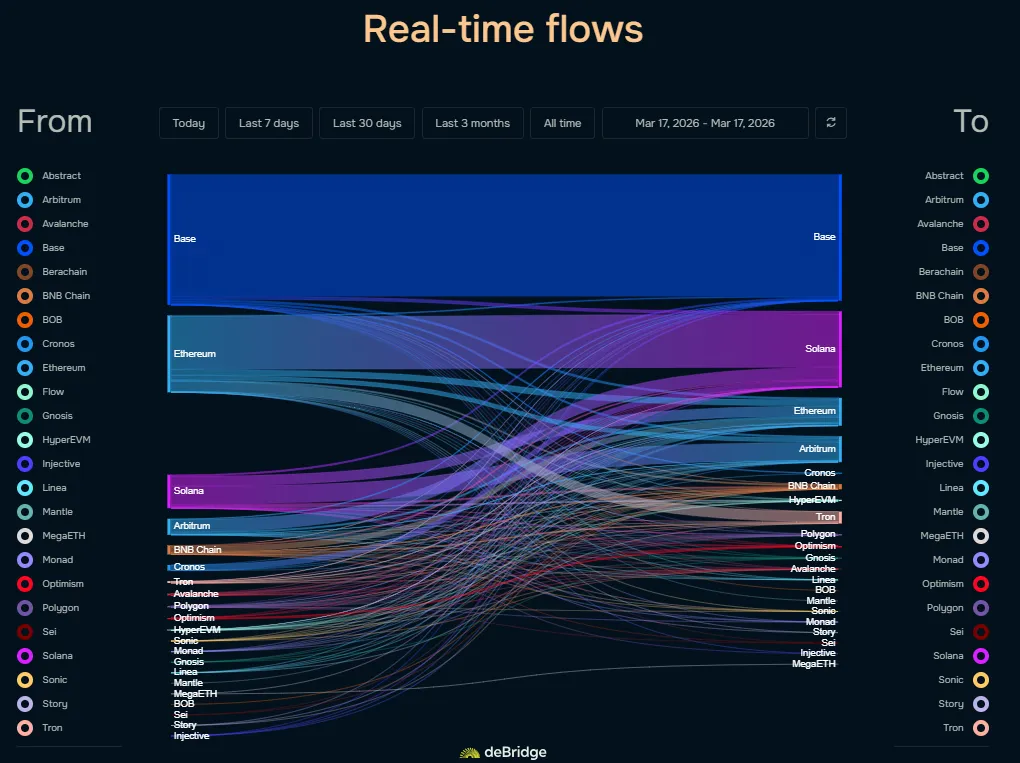
The team has moved consistently since mainnet launch in 2022. The TRON integration in August 2025 was a significant expansion, enabling direct TRC-20 and USDT swaps between Tron and 25 other chains without wrapped assets. Given that Tron now accounts for 40% of deBridge's monthly volume and provides access to $82 billion in USDT liquidity, that integration was a material revenue driver.
deBridge Bundles, launched in December 2025, is the multi-step atomic transaction feature. The MCP integration in February 2026 is arguably the most forward-looking product development to date. By enabling AI agents and developer tools including Claude and Copilot to execute cross-chain swaps and bridging operations programmatically, deBridge has positioned itself at the intersection of cross-chain infrastructure and the emerging AI agent economy.
On the roadmap, the team has targeted native Bitcoin swaps via Solana's settlement layer for Q2 2026. The goal is to allow instant BTC transfers into DeFi ecosystems without wrapped Bitcoin, which would open access to a market cap significantly larger than any chain deBridge currently serves. Full governance decentralization to DBR stakers is also targeted for 2026, which would transition protocol parameter control from the team to the community.
deBridge vs Traditional Bridges: A Different Security Model
Most bridges lock assets in pools and create wrapped tokens. deBridge does neither. Here is what that difference means in practice for security and capital efficiency.

An Assessment of Where deBridge Stands
deBridge has built something technically differentiated in the bridge space. The zero-TVL model genuinely eliminates the attack surface that has cost the industry billions. The validator slashing mechanism creates real accountability. The Reserve Fund buyback is one of the more elegant token demand mechanisms in DeFi, because it ties value directly to protocol activity rather than narrative.
The honest risks are supply-side pressure from vesting schedules, competition from well-capitalized rivals like LayerZero, and the question of whether the $100,000 daily fee rate is sustainable as competition in cross-chain infrastructure intensifies. The protocol is still relatively early on its roadmap, and governance decentralization has not yet fully transferred to the community.
What works clearly in deBridge's favor is the combination of technical credibility, a founder with a serious research background and direct experience in the problem space, and a track record of zero exploits and zero downtime since mainnet. In a category defined by catastrophic failures, those two facts matter more than most metrics.