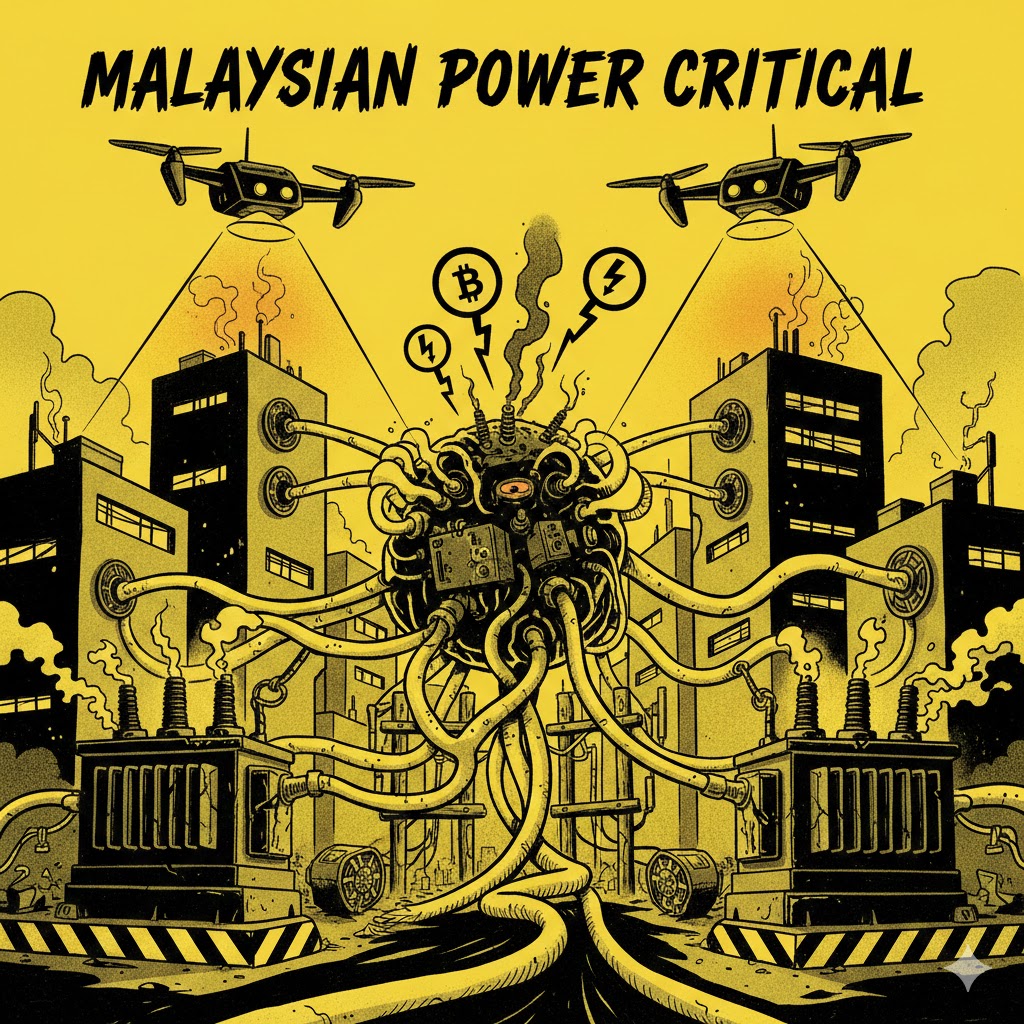
Between 2020 and 2025, a state-owned utility company identified 13,827 illegal bitcoin mining operations in Malaysia. The amount of electricity stolen is estimated to be US$1.1 billion, which would have supplied power to 373,000 homes or 567,000 Malaysians for one year. The Malaysian government fears that the amount of electricity taken illegally could destabilize the economy if it grows too large.
The Malaysian government set up multi-agency task groups and employed drone technology and handheld thermal cameras to discover approximately 14,000 illegal bitcoin mining operations throughout the country. They discovered that the illegal operations were not just a crime wave, but rather a problem with bitcoins that had systemic economic implications.
While cryptocurrencies have their share of issues, the main issue concerning illegal mining operations is the incentive structure supported by bitcoin's proof-of-work model of consensus. Because the economic incentives associated with bitcoin's energy-intensive consensus method drive people to steal electricity for bitcoin mining, it is possible to potentially bankrupt electricity grids of the nation of Malaysia along with other countries as the number of stolen electricity mining operations increases.
How Bitcoin Mining Triggered a Surge in Power Theft
Malaysia's Energy Ministry confirmed in a parliamentary filing that TNB identified 13,827 premises illegally siphoning power for cryptocurrency mining between 2020 and August 2025, resulting in losses of 4.57 billion ringgit ($1.1 billion). Because of the increase in the number of reported incidents of electricity theft rising from 607 in 2016 to 2377 in 2020, the number of stolen electricity cases increased by approximately 300%, and at least 3,000 more cases were filed before October of 2020. According to reports of Energy Minister Nasrullah Nasir, on November 15, 2016, a special committee would be formed with members of Bank Negara Malaysia, the Ministry of Finance and TNB to investigate, locate, and punish individuals or organisations that committed electricity theft.
When it comes to mining Bitcoin, its profitability is based on three factors; pricing, network difficulty, and energy. Energy is the only variable that miners have control over. Prices are set by the market and the more miners that join the network, the harder it becomes to mine. By keeping a few percentage points in savings on their energy costs, miners can succeed.
Miners in Malaysia take advantage of the subsidized electricity rates that they receive compared to the rates received by miners in Germany ($0.30 kWh) and Japan ($0.25 kWh). For industrial users, the average electricity cost is $0.12-$15 kWh while for residential users, it is $0.08-$10 kWh. However, illegal miners gain a significant competitive advantage because they steal electricity.
Miners often use sophisticated methods of meter tampering and utilize bypasses to run power cables directly from power supplies. Illegal miners may be found operating from warehouses, abandoned forestry sites, half-finished shopping malls facing the Malacca Straits, coastal cities and lock-ups. In an effort to cover up the noise of the thousands of pieces of mining equipment running day and night, some illegal miners play U.S. birdsong loops on repeat.
According to Wolfie Zhao, TheMinerMag's Chief of Research, Electric companies have found that Bitcoin mining has historically benefitted from theft of electricity over other electric usages. For this reason, it is extremely low-cost to steal electricity for an illegal Bitcoin miner.
Unfortunately, Malaysia is not alone in battling electricity theft. In December 2022, Kazakhstan banned Cryptocurrency mining as a direct result of theft; illegal Bitcoin miners have consistently displaced electrical infrastructure in Iran.
Malaysia’s High-Tech Crackdown on Illegal Bitcoin Mining
Malaysia initiated a comprehensive enforcement operation with sophisticated technology to combat illegal mining. Drones equipped with thermal imaging cameras detect heat signatures generated by illegal mining activities, which increase the ambient temperature of a given area by 10 – 20 degrees Celsius above the average. To identify mismatches between electricity usage and building records, agents on the ground employed handheld sensors to track electricity usage trends.
Electricity provider Tenaga Nasional Berhad (TNB) began tracking homeowners and tenants identified as potentially stealing electricity using its internal database system. The use of either smart meters or substation monitoring systems to identify irregularities triggered the enforcement response. TNB implemented the "Distribution Transformer Meter" in its substations to record real time electricity usage data and identify any abnormalities in usage patterns.
Operation Letrik is a cooperative effort among TNB's SEAL (Special Enforcement Anti-Larceny) Unit, Criminal Investigation Department (CID), local municipalities, regulatory agencies, and other stakeholders. Raids under Operation Letrik resulted in seizure of equipment and arrest of meter tampering suspects as well as imposition of penalties under Section 33(5) of the Electricity Ordinance pursuant to fines of up to RM 100,000 ($24,000) and/or imprisonment.
In August 2025, authorities arrested seven suspects, three of whom were Malaysian and four who were foreign, for conducting illegal mining activities. During this operation, authorities confiscated 52 cryptocurrency mining rigs with an estimated value of RM 250,000 ($60,000). Also, they seized 31 alleged miners and 45 alleged offenders during similar operations throughout the Manjung District with estimated monthly revenue of RM 36,000 ($8,600).
The Hidden Collateral Damage of Illegal Bitcoin Mining
Illegal miner tenants owe 45 landlords RM8.5 million ($2 million) in electricity payments. These renters registered TNB accounts under false identities, installed mining equipment, then vanished, leaving property owners liable. TNB helps landlords and promotes "Change of Tenancy" applications to prevent future incidents.
Illegal mining endangers public safety and grid stability beyond financial costs. "The threat isn't just theft anymore," cautions Deputy Minister Akmal. "It's about infrastructure damage and grid instability." Overloaded transformers and distribution cables can harm equipment, cause blackouts, and start fires in residential neighbourhoods where mining operations hide.
The Proof-of-Work Incentive Problem Nobody Talks About
The Malaysian crisis shows Bitcoin's infrastructure problem: proof-of-work mining's huge energy usage incentivises theft from government-owned utilities. Criminals getting free electricity outperform legitimate miners paying market prices. Become a criminal or go bankrupt.
Legalizing cryptocurrency mining in Malaysia may generate over RM700 million ($167 million) in hardware and infrastructure investment by 2025, 4,000 jobs, and RM150 million ($36 million) in annual tax revenue, according to the ACCESS Blockchain Association. These estimates require clear electricity pricing for miners, effective licensing regimes, and renewable energy tax incentives.
Bitcoin Mining in Malaysia: Regulation or Extinction
Malaysia allows cryptocurrency mining, but miners must register, pay for electricity, and follow safety regulations. Law enforcement agencies focus on fraud and theft over technological issues. Licensed operators incur higher costs because they must comply with regulations, and there is no clear guidance on what constitutes a licensed miner's rights or obligations or how much electricity an average mining operation uses.
Malaysia's recent crackdown on bitcoin mining has strengthened regulations, but that doesn't mean that those regulations will guarantee investment in bitcoin mining facilities in the long term. Investors in bitcoin mining facilities have to consider the risks of theft and regulatory uncertainty, as well as potentially having their investments eliminated by global decarbonization efforts.
The $1.1 billion dollar loss suffered by the Malaysian government illustrates the external costs associated with proof-of-work mining. As society learns more about the economics of mining and the impact of mining on national infrastructure, the validity of proof-of-work consensus mechanisms will be assessed more critically.
The challenges created by the Malaysian government's electricity theft investigation indicate that bitcoin mining can generate negative effects such as high levels of energy consumption beyond simply stealing electricity from the government. Bitcoin may continue to exist despite losing energy grids, but governments may consider proof of work as a structural threat to their infrastructure.