Property deals are stuck in 1950. You hire an agent, mortgage broker, title company, wait for escrow, sign fifty forms, and watch 5-6% of the property value evaporate in fees to buy a house. The entire procedure takes weeks or months, involves many intermediaries who take cuts, and produces a file cabinet full of papers.
Tokenised real estate promises to remedy this by putting property deeds on blockchain, permitting fractional ownership with smart contracts, and automating escrow with code instead of corporations. The promise of fast payments, transparent ownership, fractional investment from $50, and no intermediaries is appealing.
How Real Estate Tokenisation Actually Works
The lot appraisal process is pretty straightforward; it helps to determine the "market value" for a lot and is then held legally through SPV orLLC as a limited ownership entity and utilizes blockchain tokens to represent fractional ownership/income rights to the lot/entity. This allows for the automation of token transfers, dividend distributions and compliance checks through smart contracts. By buying a token, investors are able to avoid LLP or property law issues.
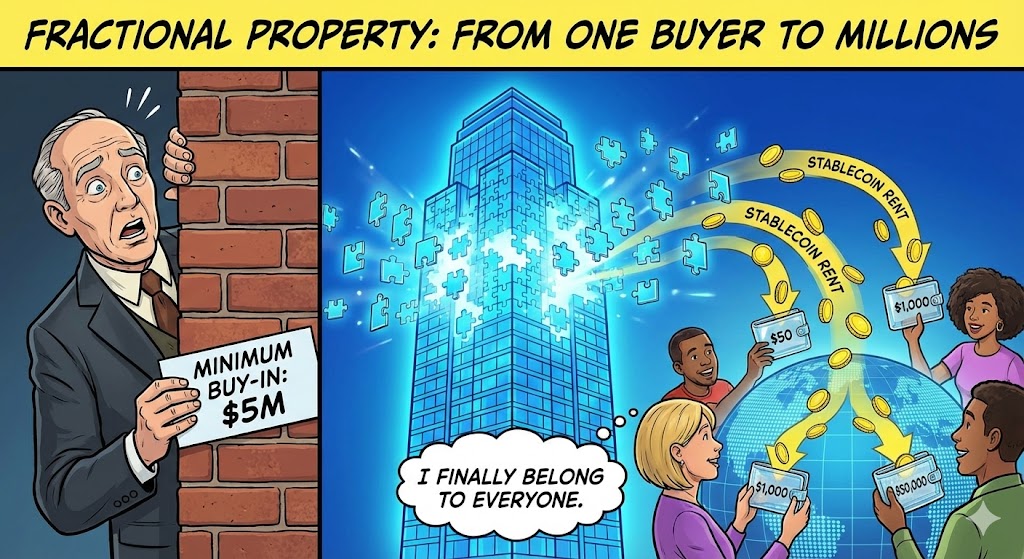
RealT and Lofty both offer rental property tokenisation. Token sales for $50 per token represent shares in the DAO LLC of that property; rental revenue generated by the rental property will be transferred as stablecoins to the wallets of all holders on a daily basis. If a holder wants to sell their token, they simply sell it on a secondary market rather than waiting for 6 months to sell the property.
Many large initiatives are creating real estate tokenisation for larger commercial properties and real estate development/property funds. Kin Capital's two $100 million real estate debt funds provide the ability for institutional investors to invest $50,000 rather than the traditional minimums of $5 - $25 million. While $50,000 is still a high amount for a typical investor, it is a significant decrease from most other RE funds.
Any transfers of ownership, funds or financial documents that are traditionally done by a lawyer or an escrow business will now be done by a smart contract; when you buy a token, the code will check that you have paid for your token, change ownership, record that information in the land registry, and distribute all income accrued by a holder of the token, all within the same moment. No more waiting for a wire transfer to clear, no more having to send documents to a title company for validation.
What Real Estate Tokenisation Actually Solves
Fractional ownership through True Unlock divides a $10 million commercial property into 10 million $1 tokens, allowing retail investors access to investment-grade commercial real estate that has historically been reserved for the wealthy and institutional investors.
The primary issue with real estate has been finding buyers, negotiating contracts/terms, and using escrow services to facilitate closing. Using exchange markets and P2P (peer-to-peer) platforms eliminates intermediaries and the associated costs. Using a smart contract will effectively accomplish all of these functions through a flat transaction fee, rather than a percentage.
Access to global markets is huge; for example, by using Stablecoins, a person from Singapore can purchase a property in Chicago without engaging in the cumbersome tasks of dealing with US banks, conducting currency exchanges, or performing wire transfers.
But, only those jurisdictions that have enacted tokenisation laws will experience the benefits associated with tokenisation; and most jurisdictions have not.
The Legal Mess That Real Estate Tokenisation Still Can’t Solve
American law does not consider blockchain as property ownership. To transfer property legally requires a written document that adheres strictly to the state's fraud statute formalities. In addition, under a legal framework of property law, property cannot be transferred through bearer instruments. In addition, electronic transaction laws may assist in transferring property, but records of the transferred property must also be recorded with the county clerk's office.
Based on the safety and security of property transfers through blockchain technology, the use of dual ledgers can prevent direct tokenisation. For example, the blockchain could claim that a token holder has ownership rights over property while the County Land Registry claims that the property belongs to an SPV (Special Purpose Vehicle). In the event that an SPV may be sued, Blockchain Technology will only allow for the transfer of an ownership token if all records agree on ownership.
Many blockchain-based projects follow the SPV model where token holders only own tokens reflecting their membership interest in an SPV that owns the property. This type of transaction is legally valid, however it centralises ownership of an asset in a single legal entity, the SPV. In addition, if an SPV mismanages its real estate or is sued, token holders' recourse is minimal.
Many federal and state regulators vary greatly in their treatment of blockchain-based property transaction regulations. The SEC has ruled that most real estate-related tokenising would be considered as securities and require either Regulation D or S exemptions to allow only accredited investors to participate in these projects. In contrast, Dubai has created a framework for direct Tokenisation. Singapore has enacted laws to recognise security tokens as legal ownership. The United States does not yet have a cohesive approach to federal and state laws governing tokenising of real estate.
Where Tokenised Real Estate Is Actually Heading
Tokenised real estate is also used in specialized markets with favorable regulations. Blockchain will be leading the way in Dubai and Singapore because their governments are actively promoting it through legislation. The US will be offering more crowdfunding and Regulation D options for commercial properties; however, there are restrictions that prevent the general population from accessing them as they are subject to securities laws.
Investors in cryptocurrency who are comfortable managing their own wallets and tokens will be using fractional ownership platforms (such as RealT and Lofty) to acquire tokenised real estate. Until this technology becomes as simple to use as buying a REIT (Real Estate Investment Trust), most traditional investors will not consider tokenisation.
Ultimately, we will continue to see hybrid types of systems, where some properties have been tokenised for a limited market, while many continue to be marketed through traditional methods.
Why Tokenised Real Estate Will Grow Slowly, Not Everywhere
Tokenised Real Estate allows fractional ownership, liquidity, lower costs and global access to real estate. The technology exists and billions of dollars worth of projects have been completed, with billions of dollars worth of transactions taking place every day.
The legal systems will not adapt quickly enough to be accepted by a majority of people around the world. Current methods of maintaining compliance through SPV wrappers preserve compliance but do not give tokenised ownership on the blockchain.
Transformation of the real estate market will not be "all property deeds being put on the blockchain". It will be through the transformation of certain properties in specific jurisdictions and through the tokenisation of properties for investors who want this type of exposure.
This is less about revolution than it is about being more practical and having a more limited scope than broad, universal adoption.
Tokenised Real Estate exists now and will exist until the legal framework enables tokenisation of properties to be widely used beyond narrow markets and experimental ventures.