Author: LBank Research Analyst: Ludo
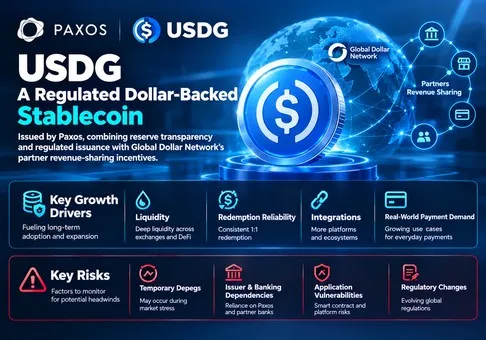
Stablecoins put dollar-denominated value on blockchains. Global Dollar (USDG) adds a business proposition: reward the companies that help distribute and use it. Understanding USDG therefore requires looking at both the token and the commercial network behind it.
1. What is USDG?
USDG is a dollar-backed stablecoin designed to maintain a value of USD 1 per token. Paxos introduced it in an announcement datelined November 1, 2024, initially on Ethereum. Its backing includes dollar deposits, short-duration US government securities, and equivalent liquid assets.
Paxos Introduces Global Dollar (USDG).
USDG and Global Dollar Network (GDN) serve different roles. USDG is the asset people transfer. GDN is the network of businesses developing its distribution, liquidity, and uses. It is a commercial ecosystem rather than another blockchain. Partners listed by the network include Anchorage Digital, Bullish, Kraken, OKX, Paxos, Robinhood, and Worldpay.
Global Dollar Network.
2. How does USDG maintain its dollar peg?
The basic mechanism combines reserve backing with issuance and redemption. As an illustration, an eligible customer providing USD 1,000 can receive 1,000 USDG; redemption reverses that process. A transfer of existing tokens between wallets does not itself create new supply.
Reserves support redemption at face value. Arbitrage can also help bring exchange prices toward USD 1 when eligible participants can buy below the peg and redeem, or obtain tokens at face value and sell above it. This is an explanation of the economic mechanism, not a promise that arbitrage will always work without costs or delays.
Paxos publishes monthly reserve attestations. Its transparency page says reports posted on or after February 27, 2026 are issued by KPMG LLP; earlier reports were issued by Enrome LLP. An attestation addresses specified assertions and reporting dates. It should not be described as a continuous guarantee or a full audit of every activity of the issuer.
Global Dollar Attestations.
The peg is a target supported by redemption rights and reserves. Exchange execution still depends on available buyers, sellers, and market depth. Direct redemption also requires satisfying the issuer's applicable terms and eligibility requirements.
3. What makes the network's economics different?
Reserve assets can generate income. GDN offers participating businesses rewards associated with holding, minting, and accepting USDG. Its website advertises up to 100% of the returns generated by the assets backing USDG held on a partner's platform. This is a conditional commercial arrangement, not a universal payout ratio for every token holder.
Global Dollar Network.
Consider a hypothetical platform maintaining average balances of 10 million USDG. At an assumed annual gross reserve yield of 4%, the corresponding gross reserve income would be approximately USD 400,000 before costs and contractual allocations. These numbers explain the incentive; they are not current USDG yields or a forecast of partner payments.
An exchange, wallet, or payment provider can therefore have a financial reason to integrate the token and develop useful services around it. Whether any benefit reaches its customers depends on that provider's product, terms, and local rules. Holding USDG in a personal wallet does not automatically entitle the holder to the network's partner revenue.
Our assessment is that USDG's distinguishing proposition is a combination of regulated issuance and distribution incentives. Its success depends on whether those incentives create recurring usage and accessible liquidity.
4. Where can USDG be used?
Potential applications include transfers between supported wallets, settlement between businesses, trading on supporting platforms, and collateral or lending on protocols that explicitly integrate the asset. A stablecoin can support a payment workflow without guaranteeing that every merchant or application accepts it.
Support now extends beyond its original Ethereum deployment. The official site lists Arbitrum, Ethereum, Ink, Mantle, Robinhood Chain, Solana, and X Layer. GDN announced native issuance on Arbitrum One on October 5, 2026.
About USDG,
Arbitrum Joins Global Dollar Network.
Blockchain transfers can run around the clock, but bank withdrawals, conversion into local currency, and compliance reviews follow their own processes. Total cost includes network fees, trading spreads, platform charges, and conversion costs. A fast blockchain transfer does not necessarily mean instant receipt of fiat money.
Before transferring, confirm that the sender and recipient support the same network and the correct token contract. The same ticker on another chain does not by itself establish compatibility.
5. How does USDG compare with USDT and USDC?
All three seek dollar price stability, but their reserve disclosures and distribution arrangements differ.
|
Comparison
|
USDG
|
USDC
|
USDT
|
|
Organisation
|
Paxos; Singapore and EU issuing entities
|
Circle
|
Tether
|
|
Reserve disclosure
|
Monthly attestations
|
Monthly third-party assurance; reserve information also disclosed more frequently
|
Typically quarterly reserve reports
|
|
Reserve approach
|
Dollar deposits and high-quality liquid dollar assets
|
Bank deposits, short-term Treasuries, and overnight Treasury reverse repos
|
Multiple reserve categories, including exposures beyond cash and Treasuries
|
|
What users should compare
|
GDN integrations, actual liquidity, and access
|
Supported services, actual liquidity, and access
|
Supported services, actual liquidity, and access
|
The presence of partner incentives does not establish that USDG has better execution everywhere. Nor should revenue sharing be described as unique across the industry: Circle also reports distribution arrangements, including payments associated with Coinbase. The relevant comparison is how each model works and what users actually receive.
Circle 2025 Form 10-K.
6. What risks and developments matter?
Liquidity and temporary price deviations. A thin market can produce slippage or discounts even when an issuer reports adequate reserves. Check the relevant venue and network rather than assuming identical liquidity everywhere.
Issuer, banking, and redemption dependencies. Reserve-backed tokens depend on asset custody and functioning redemption processes. USDG itself is not covered by FDIC deposit insurance. Paxos also retains freeze and upgrade powers under its terms, including obligations to comply with legal directives.
US Dollar-Backed Stablecoin Terms and Conditions.
Application and technology risk. Lending, liquidity pools, bridges, and custodial platforms introduce risks beyond holding the native token. Any advertised yield should be assessed together with its source, withdrawal terms, and potential losses.
Regulatory change. MAS published a stablecoin legislative consultation on September 1, 2026; consultation closed on October 16. Its proposals distinguish passive holder interest from commercial revenue-sharing arrangements. A closed consultation does not itself make a proposal binding law.
MAS consultation,
MAS Consultation Paper — September 2026, section 3.
The next measures of progress are useful integrations, market depth, reserve disclosure continuity, and reliable redemption. In our assessment, USDG has a credible route to broader distribution, but partner announcements alone do not demonstrate durable payment demand. For users, the practical question is whether the token works reliably, at a reasonable total cost, in the services they need.
7. Sources
Information checked on October 23, 2026. The KuCoin article supplied as a reference informed the choice of introductory topics; current product and regulatory facts were checked against primary sources. This article does not provide a live market-cap snapshot or verify trading availability on LBank.
Disclaimer: This article is for information and research discussion only. It does not constitute investment advice, a trading instruction, or a guarantee of returns. Product availability and applicable rules vary by jurisdiction and may change.



 Transfer