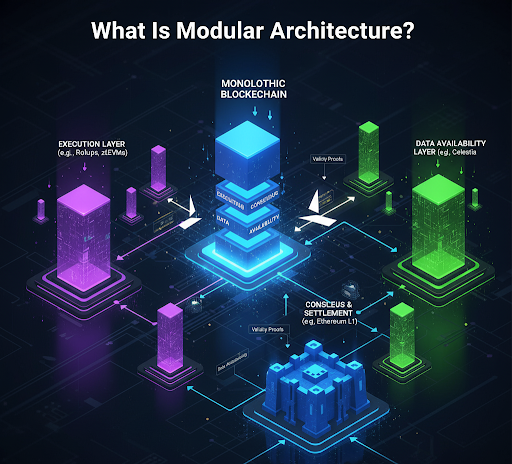
Modular blockchain architecture is a new design philosophy that offers a future vision of highly scalable, specialized networks with seamless interoperability by decoupling core blockchain functions into specialized, interchangeable layers.
The modular approach is nothing like the monolithic design that the early blockchains had, which, though safe and straightforward, gave the feeling that it's impossible to achieve decentralization, security, and scalability at the same time.
It proposes "unbundling" the blockchain functions into different layers, with one layer managing consensus, another guaranteeing data availability, and a third carrying out transactions.
This separation unlocks scalability, performance, and flexibility without sacrificing decentralization or security.
The Decoupling of the Blockchain Stack
Modular architecture is basically about specialization through division, as it divides the specialized concepts or levels comprising the decoupling of the blockchain stack into different layers, each of which focuses on either one or two primary responsibilities. The four major decoupling layers are:
- Execution Layer: This layer is the engine where the computation happens and where users interact with dApps. Smart contracts are executed, and transaction processing is done in this layer, with its dominant form (rollups) executing transactions off-chain before posting results to the Settlement layer. It determines the new state of the blockchain based on the transactions.
- Consensus Layer: This is the "court system” of the blockchain. It is primarily responsible for placing transactions in order and ensuring that all parties in the network reach consensus regarding the order of state updates and their validity. It offers the primary security mechanism of the network.
- Data Availability Layer: This layer guarantees that all the block transaction data gets published and is easily available to all users of the network. This is very important in enabling full nodes and light nodes (especially those verifying Rollups) to conduct proper verification of the chain state and fraud detection. Without reliable DA, nodes cannot verify the state of the chain, thus leading to trust issues.
- Settlement Layer: This layer serves as an optional, specialized hub where execution layers (like rollups) finalize transactions, verify cryptographic proofs (e.g., fraud or validity proofs), handle disputes, and bridge assets securely. This layer does not need to handle consensus or data availability on its own, but it would offer a trusted setting where execution chains can anchor state updates for interoperability, thus enhancing security and finality without duplicating base-layer infrastructure.
Advantages of Modular Architecture
Scalability:
Modular architecture presents an opportunity to scale and optimize individual layers independently (e.g., adding more execution layers/Rollups) without putting extra loads on the base layer or compromising its security, which gives way to a higher transaction rate.
Flexibility:
Modular architecture makes it possible for developers to customize their particular execution environment without compromising base-layer security.
They are allowed to select different layers; for example, a rollup designed for high-frequency trading can optimise its virtual machine for speed, but a gaming-focused rollup can prioritise NFT transactions.
Sovereignty:
While still leveraging shared infrastructure, projects can deploy their own specific, sovereign chains (also known as AppChains or RollApps) with custom governance and fee structures tailored to their specific application.
Cost Efficiency:
With modular architecture, every chain is not obliged to run its own validator set. Bundling transactions and using cheaper data availability levels significantly reduces transaction prices for end users.
Disadvantages of Modular Architecture
System Complexity:
The major setback of the modular architecture approach is the dramatic increase in system complexity compared to a simple, monolithic chain. Building a modular system requires coordinating multiple independent components often managed by different teams or protocols, which introduces numerous new points of failure and requires sophisticated cross-chain messaging mechanisms. Even the developers must understand the nuances of the entire stack, from the L1's consensus rules to the L2's proof system and the specifics of the DA layer. This necessitates a higher level of expertise.
Conditional Security:
In modular architecture, the security of an L2 (Execution layer) is dependent on the L1 (Consensus/Settlement layer) performing its duties correctly, and the L2 correctly utilizing the L1's security mechanisms. Security relies on an "honest minority" of validators to post a proof of fraud during a challenge window. If no one posts the proof, a fraudulent state transition could go unnoticed.
Interoperability Risk:
Modular architecture naturally leads to an ecosystem of diverse, specialized chains, which can result in fragmentation. They rely on complex cross-chain bridges to move assets and data between layers. These bridges are notoriously complex and have historically been the target of the largest security exploits in the crypto space.
Economic Alignment:
The decoupling of functions can create challenges in aligning incentives across the different layers. A layer that's solely focused on a utility function like Data Availability might struggle to accumulate high value to its native token compared to an Execution layer that captures application fee value, making it difficult to incentivize a sufficiently large and secure set of validators for the core DA/Consensus network.
Conclusion
Even though modularity at the moment isn’t a silver bullet, its momentum is clear. The future of blockchain has taken a shift from the monolithic design and is no longer one gigantic chain to rule them all, but a modular ecosystem of specialised, interoperable networks, each excelling at its task, protected by shared infrastructure, and scaling in tandem.
Just like Celestia co-founder Mustafa Al-Bassam puts it:
"Modularity is to blockchains what the TCP/IP stack was to the internet."
— Mustafa AI-Bassam
As projects and a rising number of rollup-focused companies advance, the modular thesis is poised to define the next generation of blockchain infrastructure, ultimately enabling Web3's scalable, decentralised future.
This article is contributed by an external writer: Premalynn.
Disclaimer: The content created by LBank Creators represents their personal perspectives. LBank does not endorse any content on this page. Readers should do their own research before taking any actions related to the company and carry full responsibility for their decisions, nor can this article be considered as investment advice.